

Missing a dose. Taking the wrong pill. Double-dosing because you can’t remember if you already took it. These aren’t just inconveniences-they’re dangerous. In Australia, medication errors send over 200,000 people to the hospital every year, and many of them could have been avoided with better organization. Whether you’re managing a single daily pill or a complex mix of six different medications, the right system can make all the difference. The goal isn’t just to keep track-it’s to stay safe.
Why Medication Organization Matters
Half of all people with chronic conditions like high blood pressure, diabetes, or heart failure don’t take their meds as prescribed. That’s not because they’re forgetful or careless-it’s because the system doesn’t work for them. Pill bottles stacked on the counter, handwritten lists that get lost, apps that require too many steps-all of these create gaps. And those gaps lead to hospital visits, emergency room trips, and sometimes worse.
The World Health Organization says poor medication adherence costs healthcare systems billions annually. But it’s personal too. Imagine your parent lives alone. They take three pills in the morning, two at lunch, and four at night. One of them is a blood thinner. If they miss a dose, they could clot. If they take two by accident, they could bleed. A simple pill organizer isn’t just helpful-it’s lifesaving.
Manual Pill Organizers: Simple, Affordable, Reliable
The most common tool is still the basic 7-day pill box. These come in different styles: single-compartment (one slot per day) or multi-compartment (morning, noon, evening, bedtime). You fill them once a week. They cost between $3 and $25. No batteries. No Wi-Fi. No app to download.
They work well for people who have simple routines and are good at remembering to refill. But they have limits. If you miss a day, you won’t know. If you’re unsure whether you took your pill, you’re stuck guessing. And if you need to take different doses on different days-like 5mg Monday-Wednesday and 10mg Thursday-Sunday-most basic boxes can’t handle it.
Look for ones with clear labels, large print, and snap-tight lids. Some even have built-in alarms or color-coded compartments. A good one from The Senior List’s 2024 review has separate slots for each time of day, with bold text and a flip-top lid that stays open while you fill it. It’s not fancy, but it’s dependable.
Digital Pill Dispensers: Automation for Complex Regimens
If you’re taking more than four medications a day, or if your schedule changes often, a manual box won’t cut it. That’s where smart dispensers come in.
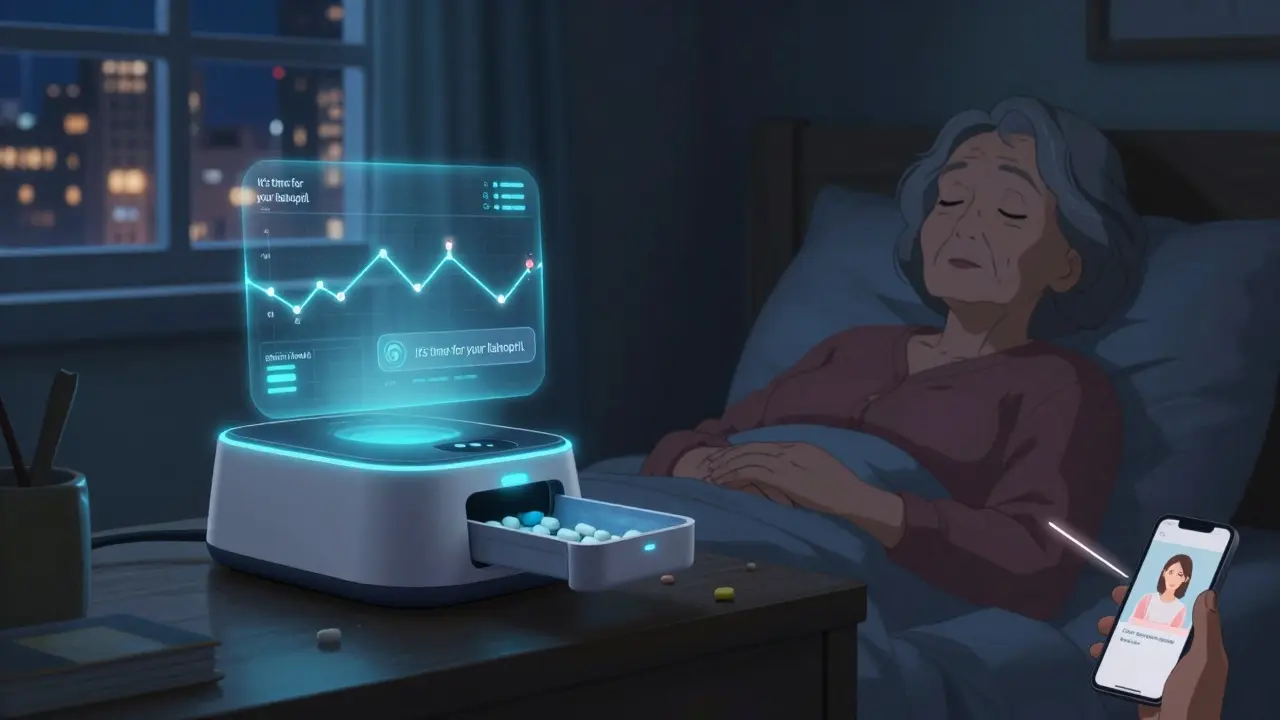
Devices like MedaCube and Hero Health are designed to handle complex routines. They hold up to 90 days of pills. They dispense the right dose at the right time with an audible alert, flashing light, and even a voice reminder: “It’s time for your lisinopril and metformin.”
Here’s how they work: You or a caregiver load the pills into the machine’s internal bins. Then, using a smartphone app or web portal, you set the schedule. The dispenser opens its compartments automatically when it’s time. If you don’t open the bin within 30 minutes, it sends a text or call to a family member. It logs every dose taken. You can check your adherence history from anywhere.
These systems aren’t cheap-MedaCube costs $1,499. But they’re not just a gadget. They’re a safety net. Studies show users of these devices have 89% adherence rates, compared to 62% with manual boxes. For someone on blood thinners, insulin, or heart meds, that jump could mean avoiding a stroke or hospitalization.
One user in Melbourne, 73-year-old Margaret Thompson, said her daughter in Perth now sleeps better knowing when she takes her pills. “I don’t have to call her every day,” Margaret said. “The system tells her.”
Pharmacy-Integrated Systems: For Care Facilities, Not Homes
While consumer devices focus on independence, pharmacy-integrated systems like DosePacker’s CareCommunityOS are built for clinics and nursing homes. These aren’t sold to individuals. They’re installed in facilities and connected directly to electronic health records.
Here’s the big difference: instead of you loading pills, the pharmacy sends pre-sorted blister packs with your name, date, and time stamped on each dose. The system scans each pack as it’s dispensed, cross-checking against your prescription. It flags mismatches before you even touch it.
This system reduces medication errors in hospitals by 23%, according to a 1994 study. It’s why most Australian aged-care homes now use some form of automated dispensing. But it’s not for home use. The setup costs $12,500 per facility. It requires trained staff. It’s designed for environments where multiple people are managing dozens of patients.
What You Need to Consider Before Buying
Not every system works for every person. Here’s what to ask yourself:
- How many medications do you take daily? If it’s 1-3, a simple organizer works. If it’s 4+, look at smart dispensers.
- Do you need reminders? Audio alerts, flashing lights, and phone calls make a huge difference for memory issues.
- Who helps you manage it? Smart devices need someone tech-savvy to set them up and refill them. If no one can do that, stick with manual.
- Do you travel? Battery life matters. Some dispensers last 30 days on one charge. Others need to be plugged in.
- What happens during a power outage? Look for models with backup batteries. 22% of users report issues when the power goes out.
- Can you afford it? Basic boxes: $5. Smart dispensers: $1,500. Monthly fees: up to $40. Budget matters.
Also check compatibility. Most apps need iOS 14+ or Android 8.0+. If you’re not comfortable with smartphones, a dispenser with a physical touchscreen might still be too confusing. A 2022 study found 37% of seniors struggled with touchscreens.
Pitfalls and How to Avoid Them
Even the best systems fail if used wrong.
Problem: Loading pills incorrectly.
Solution: Use color-coded labels. Put the same color tape on your pill bottle and the corresponding bin. Take a photo of the filled organizer as a backup.
Problem: Wi-Fi drops.
Solution: Choose a dispenser with cellular backup (available in 32% of premium models). It costs $30/month extra but keeps alerts going.
Problem: Over-relying on tech.
Solution: Always double-check the pills before you take them. One 2022 incident in the U.S. saw 14 patients given wrong doses because software misread the schedule. Machines help-but they don’t replace human oversight.
Problem: No one to refill it.
Solution: Set up a weekly reminder for a neighbor, family member, or community health worker to help. Many local councils in Melbourne offer free medication support services for seniors.

What’s New in 2026
Technology is moving fast. In January 2024, MedaCube released Version 3.0 with AI that predicts when you’re likely to miss a dose-based on your past behavior-and sends a preemptive alert. It now works with Alexa and Google Home. DosePacker’s 2025 update connects directly with 92% of Australian pharmacies. That means your prescription can be automatically loaded into your dispenser without you lifting a finger.
But the biggest shift isn’t tech-it’s policy. Australia’s Therapeutic Goods Administration is working on new guidelines for medication devices, expected later this year. It could mean better safety standards, clearer labeling, and more affordable options.
What Works Best for You?
There’s no one-size-fits-all. If you’re young, tech-savvy, and on one or two meds, an app like PillDrill might be enough. If you’re older, taking multiple drugs, and live alone, a smart dispenser is worth the investment. If you’re caring for someone else, look for systems with caregiver portals-ones that send you alerts when a dose is missed.
Start simple. Buy a $10 7-day organizer. Fill it for a week. See how it feels. If you’re still forgetting, upgrade. If you’re overwhelmed, ask your pharmacist. Most offer free medication reviews. They’ll help you simplify your regimen, cut unnecessary pills, and find the right system.
Medication safety isn’t about buying the fanciest gadget. It’s about building a system you can trust. One that works when you’re tired. When you’re confused. When you’re alone. That’s what matters.
What’s the cheapest way to organize my medications?
The cheapest option is a basic 7-day manual pill organizer. These cost between $3 and $15 and are sold at pharmacies, supermarkets, and online. You fill them once a week. They don’t have alerts or tracking, but they prevent mixing up pills and help you remember if you’ve taken your dose. For people with simple routines, this is enough.
Do smart pill dispensers really improve adherence?
Yes, studies show they do. A 2022 review from the National Bureau of Medication Tracking found that users of smart dispensers had 89% adherence rates, compared to 62% for those using manual pill boxes. The key features that drive this improvement are automated reminders, caregiver alerts, and dose logging. For people with memory issues, chronic conditions, or those living alone, these systems significantly reduce missed doses.
Can I use a smart pill dispenser if I’m not tech-savvy?
It depends. Some dispensers, like MedaCube, have large touchscreens and voice alerts designed for seniors. But setup still requires someone who can use a smartphone or computer to link the device to an app. If you have no one to help you set it up, a manual organizer or a simple dispenser with physical buttons and audio alerts may be better. Look for models with one-touch refill buttons and pre-programmed schedules.
What should I do if my smart dispenser stops working?
Always have a backup. Keep your original pill bottles with clear labels. If your dispenser fails, switch back to them immediately. Most devices come with a 1-year warranty. If it breaks after that, check if the manufacturer offers repair services-some charge hundreds for fixes. In the meantime, ask your pharmacist if they offer a temporary refill service or if your local community health center can help you manage your meds.
Are there government or Medicare subsidies for pill organizers?
In Australia, the government doesn’t directly subsidize pill organizers or smart dispensers. However, if you’re on the Pension or receive a Carer Payment, you may qualify for assistance through the National Disability Insurance Scheme (NDIS) or your local aged-care provider. Some community health services in Melbourne offer free medication management support, including free pill boxes and refill help. Ask your pharmacist or call My Aged Care on 1800 200 422.
Can I use an app instead of a physical organizer?
Yes, apps like PillDrill and Medisafe are popular and work well for people who are comfortable with smartphones. They send reminders, track doses, and can alert family members. But they require you to manually log each pill taken. If you forget your phone, or if the battery dies, you lose the system. For seniors or those with memory problems, a physical dispenser with built-in alerts is more reliable than an app.
Next Steps
Start today. Grab a pill organizer from your local pharmacy. Write down every medication you take, including vitamins and supplements. Note the time, dose, and reason for each. Then, sit down with your pharmacist. Ask: “Can you help me simplify this?” Many people can cut down their meds by 20-30% without losing effectiveness.
If you’re caring for someone else, set up a weekly check-in. Help them refill their organizer. Test the alarms. Make sure the system still works. Medication safety isn’t a one-time fix-it’s an ongoing habit. And it’s one of the most powerful things you can do to protect someone’s health.


Hi, I'm Caden Lockhart, a pharmaceutical expert with years of experience in the industry. My passion lies in researching and developing new medications, as well as educating others about their proper use and potential side effects. I enjoy writing articles on various diseases, health supplements, and the latest treatment options available. In my free time, I love going on hikes, perusing scientific journals, and capturing the world through my lens. Through my work, I strive to make a positive impact on patients' lives and contribute to the advancement of medical science.