
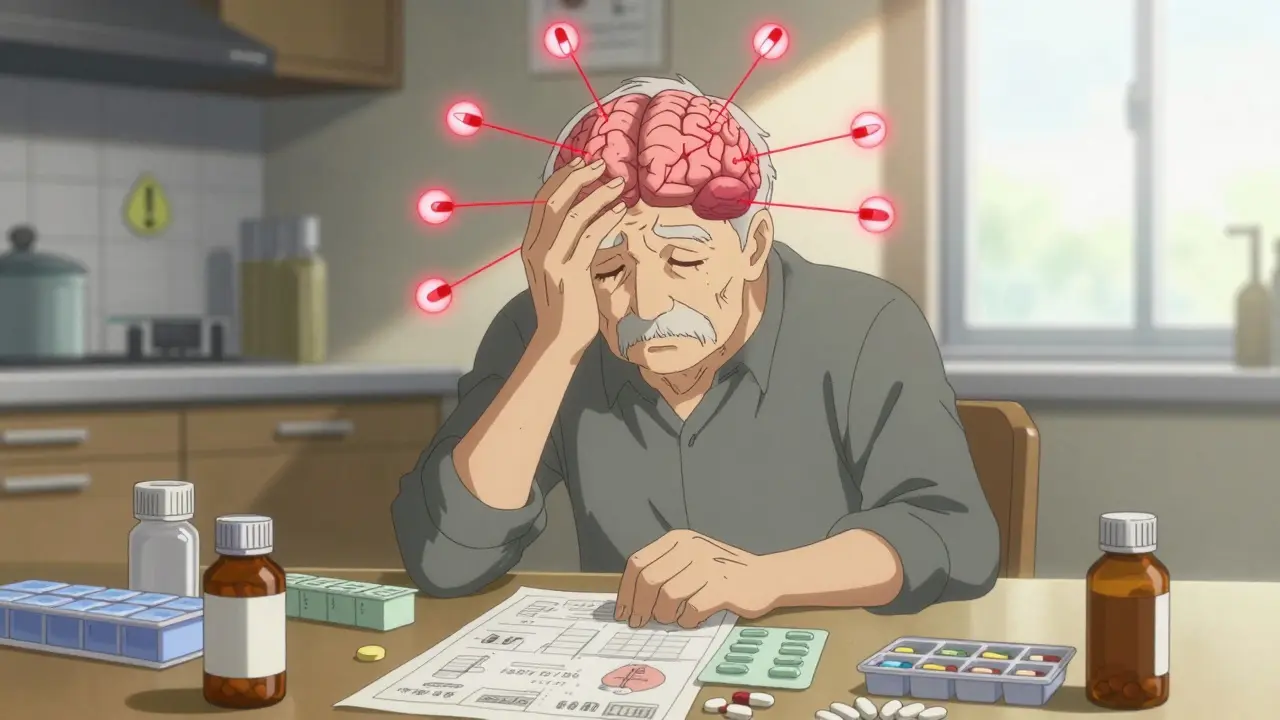
Polypharmacy Risk Assessment Tool
How Many Medications Are You Taking?
Enter the number of prescription medications, over-the-counter drugs, vitamins, and supplements you regularly take.
When you’re taking five or more medications every day, it’s not just a list on a pill organizer-it’s a ticking time bomb. Polypharmacy isn’t a buzzword. It’s a real, measurable threat to your health, especially as you get older. And it’s more common than you think. In the U.S., nearly half of adults over 65 are on five or more prescription drugs. Some are taking 10, 12, even 17 pills a day. For many, it started with one medication for high blood pressure, then another for arthritis, then a sleep aid, then a stomach pill, then a cholesterol drug. Before you know it, you’re not just managing your health-you’re drowning in it.
Why More Medications Don’t Mean Better Health
It’s easy to assume that if one pill helps, two must help more. But the body doesn’t work like that. Each medication you take interacts with your liver, kidneys, brain, and gut in ways that aren’t always obvious. When you stack five or more drugs together, those interactions multiply. A 2016 study in BMJ Open found that people taking 10 or more medications had a 28% higher risk of dying within a year than those taking just one to four. That’s not because the drugs are bad-it’s because they’re too many. The biggest danger? Adverse drug events. These aren’t rare accidents. They’re predictable, preventable, and happening every day. One of the most common is a fall. Medications like sedatives, blood pressure pills, and even some antidepressants can make you dizzy or unsteady. A 2019 report from the American Academy of Family Physicians showed that each extra pill you take raises your risk of a serious fall by 10-15%. That means someone on seven medications has nearly double the fall risk of someone on two. And falls don’t just mean bruises-they mean broken hips, long hospital stays, and loss of independence.What Makes Polypharmacy So Dangerous
It’s not just the number of pills. It’s what’s in them. Certain drugs are known troublemakers when combined. Anticholinergics-used for overactive bladder, allergies, and even some depression-can cause confusion, memory loss, and dry mouth. Benzodiazepines, often prescribed for anxiety or sleep, increase dementia risk and make falls more likely. Non-steroidal anti-inflammatory drugs (NSAIDs) like ibuprofen can damage your kidneys and stomach, especially when mixed with blood thinners or blood pressure meds. Then there’s the medication cascade. This is when a side effect from one drug gets misdiagnosed as a new condition-and another drug is prescribed to treat it. For example: You take a blood pressure pill that causes dizziness. Your doctor prescribes a balance medication. That makes you sleepy. Now you’re given a stimulant. Suddenly, you’re on six pills to fix problems created by the first one. A 2019 JAMA Internal Medicine study found that 30-40% of unnecessary prescriptions in older adults come from these cascades. And let’s not forget the cost. In 2022, Medicare data showed that people on five to nine medications paid an average of $317 a month. That’s over $3,800 a year. For someone on a fixed income, that means choosing between medicine and food. One patient, Robert, 68, told UCI Health: “I had to skip my heart pill so I could afford my insulin.” That’s not an anomaly. A 2021 study in the Journal of General Internal Medicine found that 65% of people on 10 or more drugs skipped doses because of cost.When Multiple Medications Are Necessary
Not all polypharmacy is bad. Sometimes, taking multiple drugs is the only way to survive. Someone with heart disease might need a beta blocker, a statin, an antiplatelet, and an ACE inhibitor. Together, those four drugs can cut their risk of another heart attack by half. Someone with diabetes, kidney disease, and high blood pressure might need three or four different meds just to keep their organs from failing. The difference between good and bad polypharmacy isn’t the number-it’s the reason. The World Health Organization calls it “appropriate polypharmacy” when each drug is necessary, well-monitored, and aligned with your goals. It’s “inappropriate” when it’s routine, outdated, or just hanging on because no one ever stopped to ask, “Do you still need this?”
The Hidden Toll on Daily Life
Beyond falls and costs, polypharmacy steals your freedom. People on multiple drugs report feeling like “a pharmacy on legs.” They forget which pill to take when. They avoid social events because they’re too tired, too dizzy, or too worried about side effects. A 2018 study in the Journal of the American Geriatrics Society found that 68% of older adults on five or more medications said their quality of life had dropped. One woman on Reddit, NurseJen87, shared a case where a 78-year-old patient was taking 12 pills. After cutting three unnecessary ones, the patient’s confusion and dizziness vanished. “She started gardening again,” she wrote. “That’s what recovery looks like.” And it’s not just seniors. Younger people with chronic conditions-like lupus, multiple sclerosis, or severe depression-are also caught in the web. One 42-year-old woman I spoke with was on eight medications for migraines, anxiety, acid reflux, and thyroid issues. She said she spent more time researching drug interactions than she did working. “I feel like my body is a science experiment,” she told me.Deprescribing: The Quiet Revolution
There’s hope. It’s called deprescribing. Not stopping everything-but carefully, safely, removing what’s no longer helping. The process isn’t quick. It takes 3 to 6 months. It requires a doctor who listens, not just prescribes. And it starts with a full medication review. The American Geriatrics Society recommends that anyone on five or more medications get a yearly review. During that review, your doctor should ask: Is this drug still needed? Is it causing side effects? Is there a safer alternative? Are you even taking it? Tools like the Beers Criteria-a list of medications that are risky for older adults-help guide these decisions. Drugs like diphenhydramine (Benadryl), long-acting benzodiazepines, and certain painkillers are flagged as high-risk. But the real work is personal. One patient, Martha, 72, was taking 17 pills a day. Her doctor found three that were duplicates, two that were for conditions she no longer had, and one that was causing her severe constipation. After removing those five, she felt like a new person. “I didn’t realize how tired I was until I wasn’t tired anymore,” she said.
What You Can Do Right Now
You don’t have to wait for your next appointment to take control. Here’s what to do today:- Make a complete list of every pill, vitamin, supplement, and over-the-counter drug you take-including creams and eye drops.
- Bring that list to your doctor. Don’t assume they know what you’re taking.
- Ask: “Is this still necessary? Could any of these be stopped safely?”
- Ask about alternatives. Could a lower dose work? Could lifestyle changes replace one of these?
- Track side effects. Write down dizziness, confusion, fatigue, nausea, or memory lapses-and tell your doctor.
- Use a pill organizer with alarms. But don’t let it replace asking questions.
The Bigger Picture
Polypharmacy isn’t just your problem-it’s a system failure. Only 12% of medical schools in the U.S. teach students how to safely reduce medications. Only 28% of primary care doctors have systems in place to manage complex regimens. Meanwhile, the cost of polypharmacy-related hospitalizations in the U.S. is estimated at $300 billion a year. The FDA approved its first deprescribing tool, MedWise, in 2022. It helps doctors spot dangerous combinations before they’re prescribed. But technology won’t fix this alone. It takes patients speaking up. It takes doctors listening. It takes a shift from “more is better” to “less is more when it’s right.”Final Thought
Medications save lives. But they can also take them away-if you’re not careful. The goal isn’t to stop all drugs. It’s to make sure every pill you take has a reason, a benefit, and a plan. If you’re on five or more medications, don’t accept it as normal. Ask for a review. Ask for a plan. Your body-and your future-deserve nothing less.What is considered polypharmacy?
Polypharmacy is formally defined as taking five or more medications regularly. This includes prescription drugs, over-the-counter medicines, vitamins, and supplements. While the number five is a common benchmark, the real issue isn’t the count-it’s whether each medication is still necessary, safe, and working as intended.
Can polypharmacy cause dementia?
It doesn’t directly cause dementia, but it significantly increases the risk. Medications with anticholinergic properties-like some sleep aids, allergy pills, and bladder treatments-can cause confusion, memory problems, and brain fog. Long-term use of these drugs has been linked to higher rates of cognitive decline. A 2019 study found that people taking three or more anticholinergic medications had a 50% higher risk of developing dementia over 10 years.
How do I know if I’m on too many medications?
Signs you might be on too many include: forgetting which pills to take, feeling dizzy or confused, having frequent falls, experiencing new side effects after starting a new drug, or spending more time managing medications than living your life. If you’re taking five or more, it’s time for a review-even if you feel fine.
Can I stop my medications on my own?
Never stop a medication without talking to your doctor. Some drugs, like blood pressure or antidepressant pills, can cause dangerous withdrawal effects if stopped suddenly. Deprescribing must be done slowly and safely, under medical supervision. But you can-and should-ask your doctor if any of your meds can be reduced or stopped.
What’s the difference between polypharmacy and appropriate medication use?
Appropriate medication use means every drug is prescribed for a clear, current condition, monitored for side effects, and reviewed regularly. Polypharmacy becomes inappropriate when medications are taken out of habit, for conditions that no longer exist, or because side effects led to more prescriptions. The goal is not fewer drugs-it’s better drugs, tailored to your needs.
Are there tools to help manage multiple medications?
Yes. Tools like MedWise (FDA-approved in 2022) help doctors spot dangerous drug combinations. Simple apps like MyTherapy or Medisafe can remind you when to take pills and track side effects. But the most powerful tool is still a conversation-with your doctor, pharmacist, or caregiver-about whether each pill still belongs in your routine.


I am a pharmaceutical expert with over 20 years of experience in the industry. I am passionate about bringing awareness and education on the importance of medications and supplements in managing diseases. In my spare time, I love to write and share insights about the latest advancements and trends in pharmaceuticals. My goal is to make complex medical information accessible to everyone.