
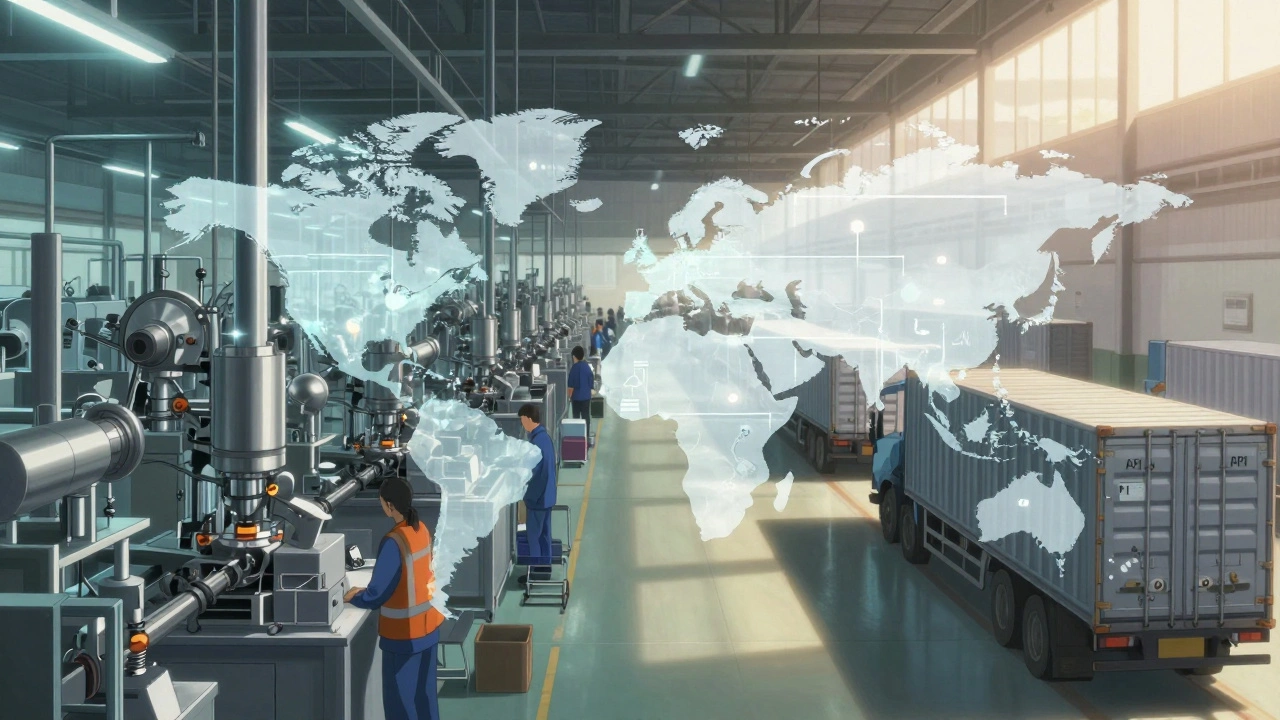
When you pick up a bottle of antibiotics, blood pressure pills, or diabetes medication, there’s a good chance it came from Asia. Not just any part of Asia - India and China together supply more than half the world’s generic drugs. But they don’t do it the same way. One wins on volume and speed. The other wins on scale and rising value. And behind them, countries like Vietnam and Cambodia are quietly carving out their own roles in this global game.
India: The Pharmacy of the World, Built on Cost and Volume
India didn’t become the top exporter of generic drugs by accident. It was policy - and timing. In the 1970s, the government changed its patent laws to allow only process patents, not product patents. That meant companies could copy any drug as long as they made it using a different chemical process. Suddenly, Indian firms could produce life-saving medicines at 1/10th the price of Western brands. That move turned India into the go-to source for the world’s cheapest pills. Today, India makes over 60% of the world’s generic vaccines and supplies nearly 40% of all generic drugs to the U.S. market. Its pharmaceutical market hit $61.36 billion in 2024, with 75% of that coming from simple, low-cost generics. Gujarat and Maharashtra are the powerhouses, home to over 3,000 FDA-approved manufacturing sites. But here’s the catch: only 15% of those sites can handle advanced biologics. Most still churn out tablets and capsules - the kind that treat high blood pressure, infections, or asthma. What keeps India competitive? Labor. Skilled workers in Indian pharma plants earn about 30% less than their counterparts in Europe or the U.S. Customer service is another edge - Indian suppliers often respond to inquiries within hours, not days. A U.S. pharmacy chain reported a 60% drop in operational issues after switching to Indian suppliers, mainly because of faster communication. But there’s a big vulnerability: India still imports 68% of its Active Pharmaceutical Ingredients (APIs) from China. That’s like building a house with bricks you don’t make yourself. The Indian government knows this. That’s why it launched Pharma 2047, a $13.4 billion plan to build 12 new API parks and cut that import reliance to 30% by 2030. Until then, India’s strength is volume, not self-sufficiency.China: The Hidden Engine Behind Every Pill
China doesn’t just make pills - it makes the ingredients inside them. The country controls about 70% of the global API market. That’s not a small share. It’s a chokehold. Nearly every generic drug made in India, the U.S., or Europe starts as a chemical compound produced in a factory in Jiangsu or Zhejiang province. China’s pharmaceutical market is bigger than India’s - $80.4 billion in 2024 - and growing faster in dollar terms, even if the percentage growth is slower. Why? Because China is moving up the value chain. While India still focuses on simple generics, China is pouring $22.8 billion into biologics and innovative drugs under its Healthy China 2030 plan. In 2024, 10% of China’s pharma output was biologics. By 2030, that number is expected to hit 25%. China’s manufacturing is more centralized. Instead of 17 different regulatory bodies like in India, companies deal with just eight national agencies. That makes compliance more predictable - but also harder to navigate for outsiders. Foreign firms must own at least 51% of a distribution company in China, a rule that blocks many Western players from direct control. Quality is the big concern. In 2024, the U.S. FDA issued 142 warning letters to Chinese manufacturers, compared to 87 for Indian ones. Many of these were about data integrity - falsified records, unclean facilities, or unapproved changes in production. One German healthcare company said it had to spend 18% more on supply chain costs just to dual-source from both countries. Still, Chinese APIs are 20% cheaper than Indian ones. For bulk buyers, that price difference is hard to ignore.
The Emerging Players: Vietnam, Cambodia, and the New Niche Markets
While India and China fight over volume and value, smaller Asian economies are playing a smarter game: specialization. Vietnam’s pharmaceutical exports jumped 24.7% in 2024 to $2.8 billion. How? By focusing on antibiotic intermediates - the building blocks for antibiotics that big pharma companies then finish into pills. It’s a narrow slice, but a profitable one. Vietnam doesn’t try to compete with China on price or India on volume. It just does one thing well and does it fast. Cambodia is even more focused. It doesn’t make drugs at all. Instead, it assembles low-cost medical devices - syringes, IV bags, glucose monitors - for export. Its medical device sector grew 32% last year, fueled by trade preferences under ASEAN agreements. These countries are learning from the giants: don’t try to be everything. Be the best at one thing. They’re also benefiting from rising distrust in single-source supply chains. After the pandemic, hospitals and pharmacies started avoiding over-reliance on any one country. That’s opening doors for Vietnam, Thailand, and Indonesia to become backup suppliers for specific products.Who Wins When Regulators Step In?
Global regulators are tightening the screws. The U.S. FDA’s Project BioSecure, launched in late 2024, now demands full traceability of every API - from the raw chemical to the final pill. That means factories need digital logs, real-time monitoring, and auditable records. For small Indian plants still using paper logs, that’s a $2 million upgrade. For Chinese factories with automated systems, it’s just a new compliance layer. The WHO reported a 27% increase in inspection failures at Asian facilities in 2024 compared to 2023. That’s not a coincidence. It’s a signal. The days of cutting corners are ending. The winners will be the ones who invest in quality, not just cost. India’s advantage? Flexibility. Indian manufacturers can adapt formulations faster. A U.S. buyer can request a slightly different tablet coating or dosage form, and an Indian company will deliver it in 14 days. In China? Minimum 30 days. That’s why many specialty drug buyers still prefer India for complex generics - like oncology drugs, where India holds a 35% global market share. China’s advantage? Scale and ambition. With $150 billion allocated over five years for biologics R&D, China isn’t just catching up - it’s trying to lead. By 2030, it could be exporting biosimilars for cancer and autoimmune diseases that rival those from the U.S. and Europe.


Hi, I'm Caden Lockhart, a pharmaceutical expert with years of experience in the industry. My passion lies in researching and developing new medications, as well as educating others about their proper use and potential side effects. I enjoy writing articles on various diseases, health supplements, and the latest treatment options available. In my free time, I love going on hikes, perusing scientific journals, and capturing the world through my lens. Through my work, I strive to make a positive impact on patients' lives and contribute to the advancement of medical science.