
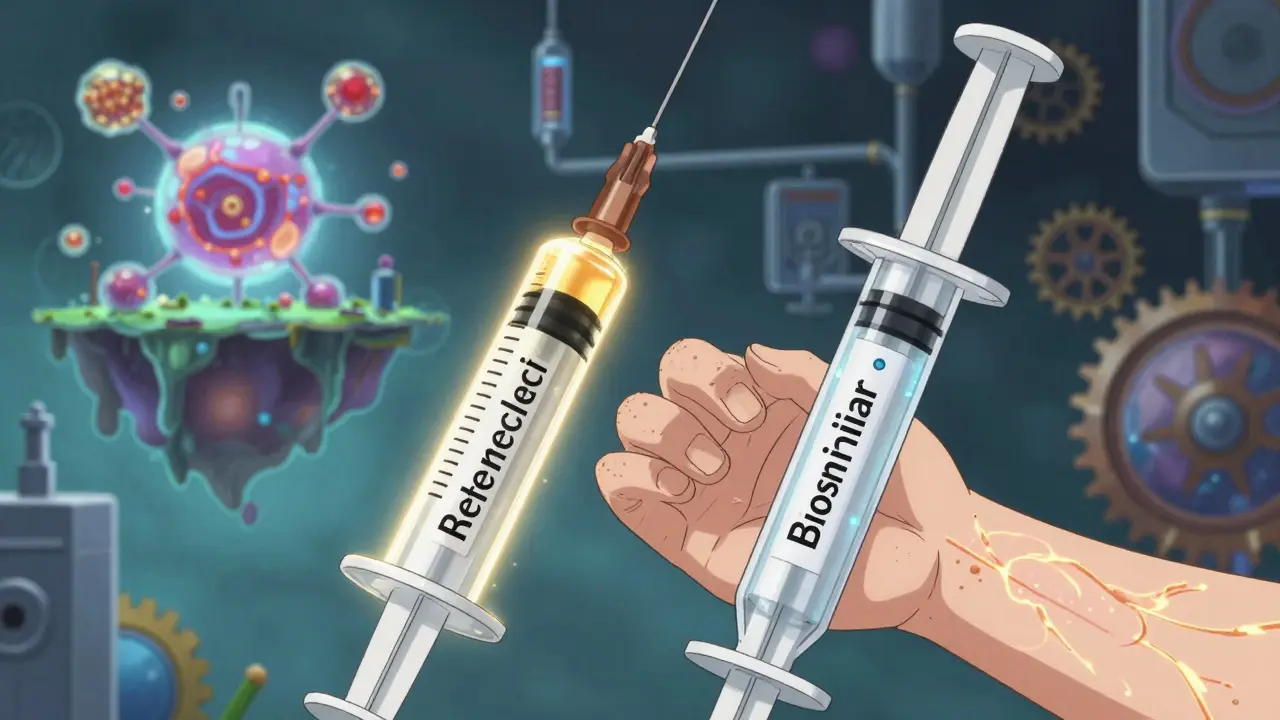
When you need a prescription drug, you might be offered a generic version - a cheaper, exact copy of the brand-name medicine. But what if your drug isn’t a pill? What if it’s an injection for rheumatoid arthritis, cancer, or diabetes? That’s where biosimilars come in. They’re not exactly like generics, but they’re the closest thing biologics have to them.
Biologics are complex medicines made from living cells - think antibodies, proteins, or enzymes. Unlike small-molecule drugs like aspirin or metformin, you can’t just mix chemicals to copy them. Even tiny changes in how they’re made can affect how they work. That’s why you can’t have an exact copy. Instead, you get a highly similar version - a biosimilar.
What Exactly Is a Biosimilar?
A biosimilar is a biologic medicine that’s almost identical to an already-approved biologic, called the reference product. The FDA doesn’t call them "copies" - they say they’re "highly similar" with no clinically meaningful differences in safety, purity, or how well they work.
Think of it like two identical-looking cars made in different factories. Same model, same engine, same safety rating. But one was built in Detroit, the other in Munich. The parts aren’t 100% the same - but they perform the same way. That’s the science behind biosimilars.
To get approved, a biosimilar must go through years of testing. Manufacturers must prove:
- It has the same mechanism of action (how it works in the body)
- It’s given the same way (injection, infusion, etc.)
- It matches in dosage, strength, and form
- It works just as well in clinical trials
- It doesn’t cause new or worse side effects
The FDA requires over 100 different tests - from molecular structure to immune response. This isn’t a shortcut. It’s a deep dive into biology.
Biosimilars vs Authorized Generics: The Big Difference
Authorized generics are simple: they’re the exact same chemical as the brand drug, made by the same company or a licensed partner. You can swap them in without thinking twice. That’s because small-molecule drugs have a fixed chemical formula. Copy it? Easy.
Biosimilars? Not so simple. Biologics are made in living systems - yeast, hamster cells, human tissue. Tiny changes in temperature, pH, or nutrient mix can create slight variations. That’s normal. That’s expected. That’s why you can’t have an exact copy.
So here’s the real contrast:
| Feature | Authorized Generics | Biosimilars |
|---|---|---|
| Drug Type | Small molecule (chemical) | Biologic (protein, antibody) |
| Copy Method | Exact chemical duplicate | Highly similar, not identical |
| Approval Pathway | ANDA (Abbreviated New Drug Application) | BPCIA (Biologics Price Competition and Innovation Act) |
| Cost Savings | 80-85% | 10-50% |
| Substitution at Pharmacy | Automatic in all states | Only if labeled "interchangeable" + state law allows |
| Market Share (U.S.) | ~90% of prescriptions | ~18% of biologic prescriptions |
That’s why biosimilars haven’t taken over like generics did. They’re not as cheap. And they’re harder to swap in.
Interchangeable Biosimilars: The Closest Thing to Generics
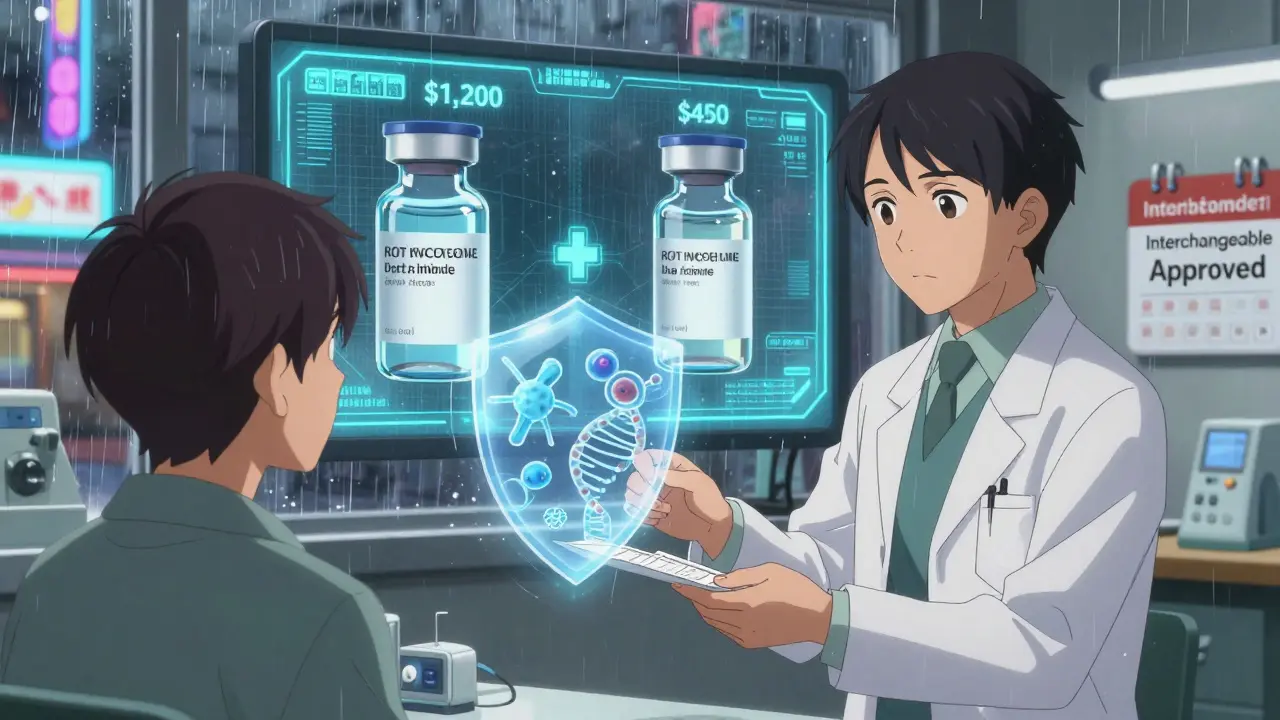
There’s a special category of biosimilars called "interchangeable." These are the ones that can be swapped at the pharmacy without asking the doctor - just like generics.
To earn that label, a biosimilar must prove it can be switched back and forth with the reference product without increasing risk. That means:
- It works the same every time you switch
- Switching doesn’t trigger new side effects
- It’s safe even if you alternate between it and the original
The first interchangeable biosimilar for Humira (adalimumab) was approved in November 2023. That’s a big deal. Humira was the top-selling drug in the U.S. for years. Now, with a cheaper, interchangeable option, prices could drop fast.
But here’s the catch: not every state lets pharmacists switch automatically. Only 32 states - including California, New York, and Texas - have laws allowing substitution without prescriber approval. In the other 18, you’ll still need a new prescription every time.
Why Aren’t More People Using Biosimilars?
Despite being approved and proven safe, adoption is slow. Why?
Doctors are cautious. Many worry about switching patients who are stable on a biologic. One oncologist told me, "I won’t switch a patient with metastatic breast cancer unless they ask. I’ve seen too many anxious faces."
Patients are confused. A 2022 survey found 41% of patients didn’t know biosimilars were safe. Some thought they were "second-rate." Others feared being a "guinea pig."
Insurance plays games. Some plans force switches to save money - even if the patient is doing fine. A rheumatoid arthritis patient in Ohio reported her insurer switched her three times in a year. She developed new joint pain after the third switch. Her doctor couldn’t prove it was the biosimilar - but she felt worse.
On the flip side, others report big wins. A woman in Texas switched from Herceptin to its biosimilar and cut her out-of-pocket cost from $1,200 to $450 per infusion. No side effects. Same results.
Who Makes These Drugs? And How Fast Are They Growing?
Big pharma is all in. Amgen has 12 approved biosimilars. Sandoz has 8. Pfizer has 7. Together, they’ve brought 76 biosimilars to market in the U.S. since 2015.
The global market was $10.1 billion in 2022. It’s projected to hit $58.6 billion by 2030. That’s a 24% annual growth rate.
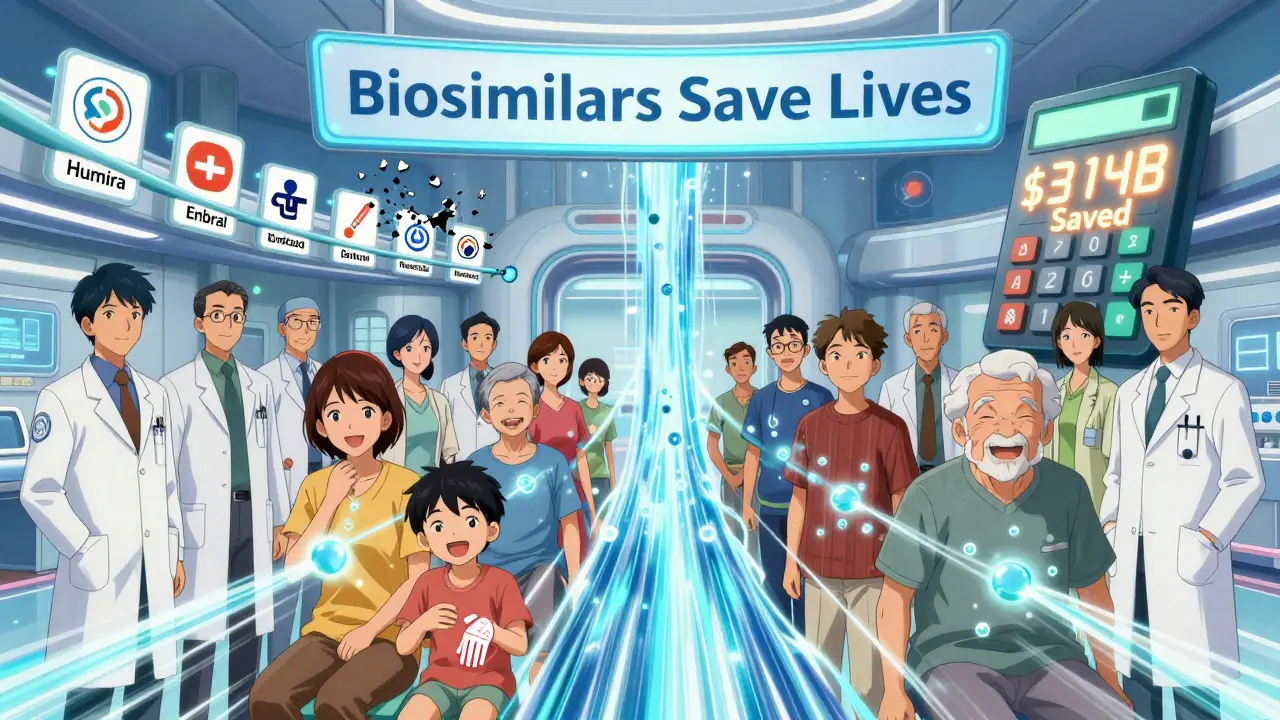
Why now? Because the patent cliffs are coming. Over $115 billion in biologic sales will face biosimilar competition by 2028. Humira, Enbrel, Remicade - all are losing exclusivity. Hospitals are ready. 87% of U.S. hospitals now have formal biosimilar adoption plans.
Medicare Part D plans are catching up too. 62% cover biosimilars at the same tier as the brand. That means lower co-pays. More access.
What’s Next?
The FDA is pushing hard. In May 2023, it updated its guidance to make approval faster and clearer. By 2025, it aims to approve 15-20 new biosimilars each year.
Meanwhile, education is key. The American College of Rheumatology says it takes doctors 6-8 hours of training to feel confident prescribing them. Pharmacies need training too. Patients need clear info.
And cost savings? The Congressional Budget Office estimates biosimilars will save Medicare $53 billion between 2024 and 2033. The whole U.S. healthcare system could save $314 billion over the next decade.
It’s not magic. It’s science. And it’s working.
Are biosimilars safe?
Yes. The FDA requires biosimilars to go through the same rigorous testing as the original biologic. They must prove no clinically meaningful differences in safety, effectiveness, or side effects. Over 76 approved biosimilars in the U.S. have been used by millions of patients with no safety concerns beyond those of the reference product.
Can I be switched to a biosimilar without my doctor’s permission?
Only if the biosimilar is labeled "interchangeable" AND your state allows pharmacist substitution. Currently, only 32 states have laws permitting this. In the rest, your doctor must approve the switch. Always check your state’s rules and ask your pharmacist.
Do biosimilars cost less than the brand?
Yes, but not as much as generics. While generics save 80-85%, biosimilars typically save 10-50%. The cost depends on competition. The more biosimilars approved for one drug, the lower the price. For example, after three biosimilars entered the market for Humira, its price dropped by 60%.
Why aren’t there more biosimilars on the market?
Manufacturing is expensive and complex. It takes years to develop, test, and get approval. Plus, brand-name companies use legal tactics - like patent lawsuits - to delay competition. Over 14 patent challenges per biosimilar are common. But that’s changing. More companies are entering the space, and regulators are pushing for faster approvals.
If I’m doing well on my biologic, should I switch to a biosimilar?
It’s your choice. If you’re stable and not experiencing side effects, there’s no medical need to switch. But if cost is a burden, ask your doctor. Many patients have switched successfully with no change in outcomes. Talk to your provider - don’t let your insurance force a switch without your input.


I am a pharmaceutical expert with over 20 years of experience in the industry. I am passionate about bringing awareness and education on the importance of medications and supplements in managing diseases. In my spare time, I love to write and share insights about the latest advancements and trends in pharmaceuticals. My goal is to make complex medical information accessible to everyone.