

PRO Impact Calculator
This calculator shows how individual patient reports contribute to drug safety data. According to the article, patient-reported outcomes are 3-5 times more effective at detecting symptoms than clinician reports alone. Your reports help identify patterns that can trigger safety alerts, dose adjustments, or drug recalls.
Your Reporting Impact
Estimated Cases
0
Patients reporting this symptom
Detection Speed
0
Days earlier than clinician reporting
Safety Signal
Not Detected
Based on FDA thresholds
This calculation shows how your consistent reporting contributes to drug safety. The article states that patient-reported outcomes are detected 14 days earlier on average than clinician-reported events. If 15% of patients report symptoms consistently, this could trigger important safety actions that might prevent hospitalizations or adverse events for many people.
Remember: Consistency matters. Daily reporting provides more reliable data than weekly reporting. Your data helps identify patterns that might otherwise go unnoticed until they affect many people.
When you take a new medication, your doctor doesn’t know everything you’re feeling. They can’t see your fatigue, your brain fog, or the way your hands shake after dinner. But patient-reported outcomes (PROs) change that. They’re your direct, unfiltered voice about how a drug really affects you - and they’re becoming essential to making medicines safer for everyone.
Think of PROs as the missing piece in drug safety. For decades, safety monitoring relied almost entirely on doctors reporting side effects during clinic visits. But many symptoms - like nausea, sleeplessness, or emotional ups and downs - are invisible to clinicians unless you mention them. And most people don’t. A 2019 FDA study found patients reported 30-40% more side effects than doctors ever recorded. Fatigue? Patients described it 4.2 times more often. Neuropathy? 3.8 times. Cognitive issues? Over five times more. That’s not just noise. That’s data that saves lives.
What Exactly Are Patient-Reported Outcomes?
A PRO is simply what you tell researchers or drug makers about your health - in your own words, using tools designed to capture your experience accurately. The U.S. Food and Drug Administration (FDA) defines it clearly: a report that comes directly from the patient, with no interpretation by a doctor or nurse. It’s not a secondhand account. It’s you, answering questions like: How often do you feel dizzy? On a scale of 1 to 10, how much has your pain worsened? Have you missed work because of side effects?
These aren’t random surveys. They’re built from years of research. Instruments like the PRO-CTCAE (used in cancer trials) include 78 specific symptoms rated by frequency and severity. PROMIS tools measure physical function with just 10-20 questions, but they’ve been tested on tens of thousands of people to make sure they’re reliable. The development of one of these tools can take 18 to 24 months and cost between $500,000 and $750,000. Why? Because if the tool isn’t accurate, it gives false signals - and that could delay a life-saving drug or let a dangerous one slip through.
How PROs Are Changing Drug Safety
Traditional safety systems rely on doctors spotting problems during visits - usually every few weeks or months. But PROs work differently. They’re collected regularly - sometimes daily - through apps, text messages, or web portals. This constant stream of data lets drug makers and regulators catch problems much earlier.
A 2018 study by the PROSPER Consortium found that patient-reported adverse events were detected an average of 14 days after they started. Clinician-reported events? 42 days. That’s over a month of difference. In cancer treatment, where a small delay can mean the difference between recovery and hospitalization, that matters.
PROs also capture symptoms that are hard to measure in a clinic. Think of brain fog after chemotherapy. A doctor might ask, “Are you having trouble concentrating?” and you say, “Sort of.” But a validated PRO questionnaire asks: “In the past 24 hours, how often did you forget what you were doing?” with options like “Never,” “Rarely,” “Sometimes,” “Often,” “Always.” That precision creates real patterns.
Today, 87% of global clinical trials use electronic PROs (ePROs). Patients answer on smartphones, tablets, or web apps. Response rates? 85-92%. That’s far higher than paper surveys, which often get lost or ignored. And it’s not just for trials. Regulators now expect PRO data in drug approvals. The FDA’s 2022 draft guidance says every new cancer drug must include PROs on symptoms, physical function, and disease-specific impacts. The European Medicines Agency plans to require PROs for all new drug applications by 2026.

What You Report Matters - Even If It Feels Small
You might think, “My fatigue isn’t that bad. Why bother reporting it?” But here’s the truth: what feels small to you might be a signal for thousands. One patient reporting mild nausea every day might seem like an outlier. But if 120 others report the same thing, that’s a pattern. And that pattern can lead to dose changes, warning labels, or even drug recalls.
One breast cancer patient on MedHelp shared: “Reporting my side effects through the CTCAE-PRO app helped my oncologist adjust my dose before I ended up in the ER.” That’s not luck. That’s PROs at work.
Even subjective symptoms like anxiety, memory lapses, or sexual side effects - things often brushed off as “just part of treatment” - become actionable data when collected systematically. The Patient-Centered Outcomes Research Institute (PCORI) has spent $127 million since 2012 to prove that outcomes patients care about are the ones that matter most.
The Flip Side: Challenges and Frustrations
PROs aren’t perfect. And patients know it.
A 2022 survey of 1,247 patients found that 68% felt they never got feedback on how their reports influenced care. You fill out a survey every few days… and hear nothing. That’s demoralizing. Another 32% struggled with technical issues - apps crashing, login problems, or confusing wording. One Reddit user wrote: “I had to complete 3 different PRO instruments 3 times weekly - it became a job rather than patient care.”
There’s also recall bias. If you’re asked to report symptoms from last week, you might forget. Studies show accuracy drops by 25% for events recalled beyond seven days. That’s why daily reporting beats weekly. And not everyone has reliable internet or a smartphone. That’s a major equity issue - especially for older adults or low-income communities.
Even worse: unvalidated tools. Dr. Janet Woodcock, former head of the FDA’s drug review center, warned that poorly designed PRO instruments can introduce error. If a questionnaire doesn’t measure what it claims to, it could lead to wrong decisions. That’s why validation matters so much. It’s not bureaucracy - it’s science.
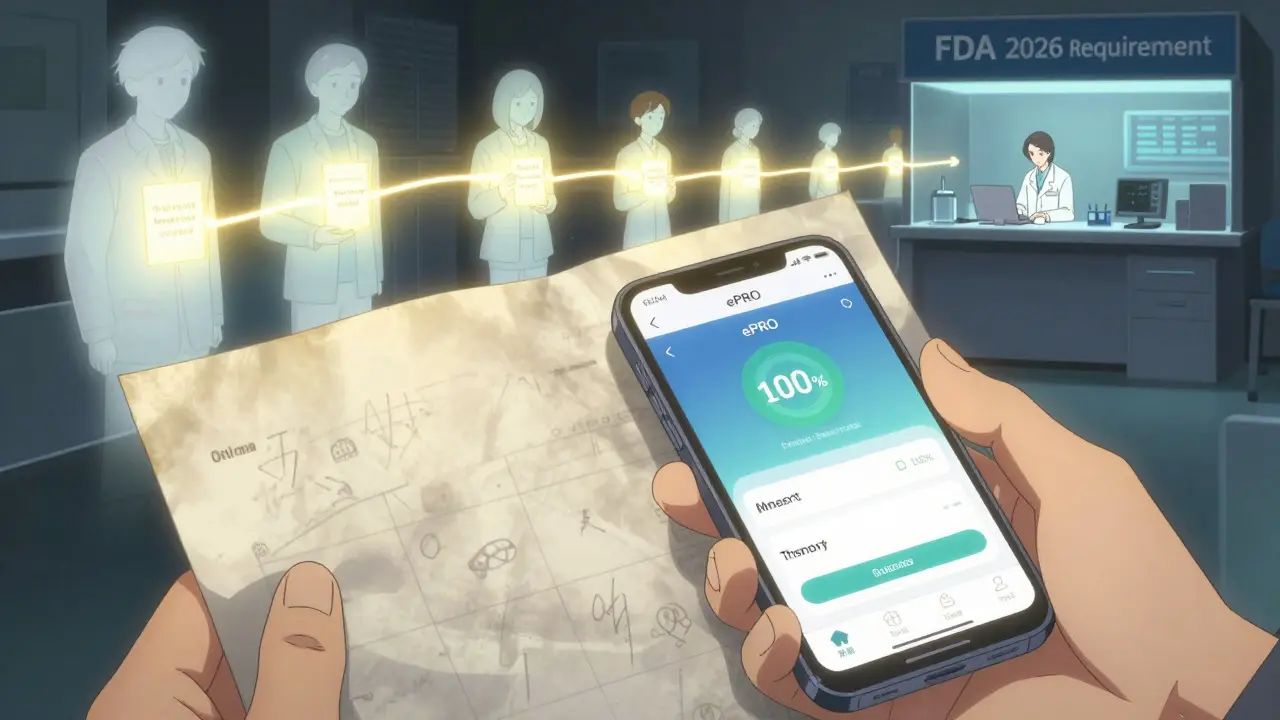
How You Can Make PROs Work Better
If you’re in a clinical trial or taking a new drug, your participation isn’t optional - it’s vital. But you can do more than just answer questions.
- Report consistently. Even if you feel fine, answer. Empty responses don’t help. Consistency builds trust in the data.
- Use the right tool. If you’re given an app, use it. If it’s paper, keep it handy. Set a daily reminder on your phone.
- Ask for feedback. Tell your doctor or trial coordinator: “Can you tell me if my reports changed anything?” If they can’t, ask to be connected to the research team.
- Speak up about barriers. If the app crashes, if questions are confusing, if you can’t afford data - tell someone. These are solvable problems, but only if they’re named.
Some trials now offer incentives - gift cards, summaries of findings, or even direct calls from researchers. That’s not bribery. It’s respect. Your time is valuable. You’re not just a data point. You’re part of the team.
The Future: AI, Wearables, and Real-Time Safety
PROs are evolving fast. Roche is using AI to scan patient messages for signs of side effects - and it’s 82% accurate at spotting problems. Pfizer tested wearables that tracked scratching in eczema patients. The device matched patient reports 73% of the time. That’s huge. It means we might soon combine your words with your body’s actual signals.
Novartis is testing blockchain systems to keep your PRO data private and secure. That’s critical. No one wants their health diary hacked.
By 2028, the global PRO market is expected to hit $3.9 billion. Why? Because regulators, drug companies, and patients all agree: the patient’s voice isn’t a bonus. It’s a requirement.
When you report your symptoms, you’re not just helping yourself. You’re helping the next person who takes that same drug. Your fatigue, your nausea, your brain fog - they’re not minor. They’re the data that makes medicine safer for everyone.
What exactly counts as a patient-reported outcome (PRO)?
A PRO is any direct report from a patient about their health, symptoms, or treatment experience - without interpretation by a doctor or researcher. This includes answers to standardized questionnaires about pain, fatigue, nausea, mood, sleep, mobility, or daily function. It’s not what a clinician observes - it’s what you feel and experience yourself.
Are PROs only used in clinical trials?
No. While PROs became common in clinical trials over the past 15 years, they’re now required for drug approval by the FDA and EMA. They’re also used in post-market safety monitoring, where patients report side effects after a drug is on the market. Some healthcare systems are even starting to collect PROs during routine visits to improve care.
Why do I have to fill out so many surveys?
Because one survey isn’t enough. Different tools measure different things - one might track pain, another fatigue, another quality of life. To get a full picture, researchers need multiple data points. But there’s a balance. Too many surveys can burn patients out. Many trials now use adaptive designs - if you report no changes, you get fewer questions next time. If you report new symptoms, you get more detailed ones.
Can I opt out of reporting PROs?
In clinical trials, participation is voluntary. You can choose not to complete PRO surveys, but that may limit the value of your data for the study. If you’re taking a drug outside a trial, PRO reporting is not mandatory - but your input helps improve future treatments. Your safety and privacy are protected under HIPAA (in the U.S.) and GDPR (in the EU).
How do I know if my PRO data made a difference?
You won’t always know - but you should. Many trials now send participants summary reports showing how their feedback shaped the study. If you don’t get one, ask. Some companies publish patient impact reports. Others host webinars where researchers explain how PROs changed dosing or led to new safety warnings. Your voice matters. You deserve to know how it was used.


I am a pharmaceutical expert with over 20 years of experience in the industry. I am passionate about bringing awareness and education on the importance of medications and supplements in managing diseases. In my spare time, I love to write and share insights about the latest advancements and trends in pharmaceuticals. My goal is to make complex medical information accessible to everyone.