
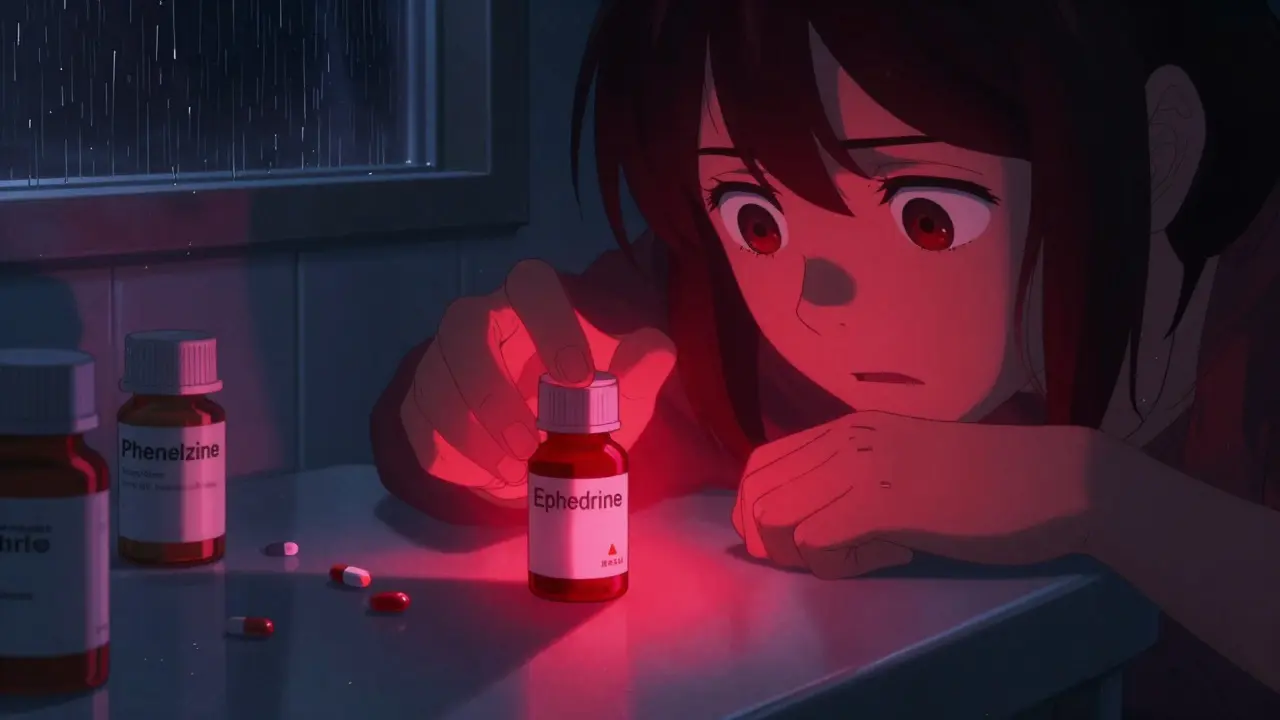
One pill. That’s all it takes. A cold medicine you picked up at the store. A supplement you thought was harmless. And if you’re taking an MAOI for depression, it could kill you-fast.
What Happens When Ephedrine Meets an MAOI?
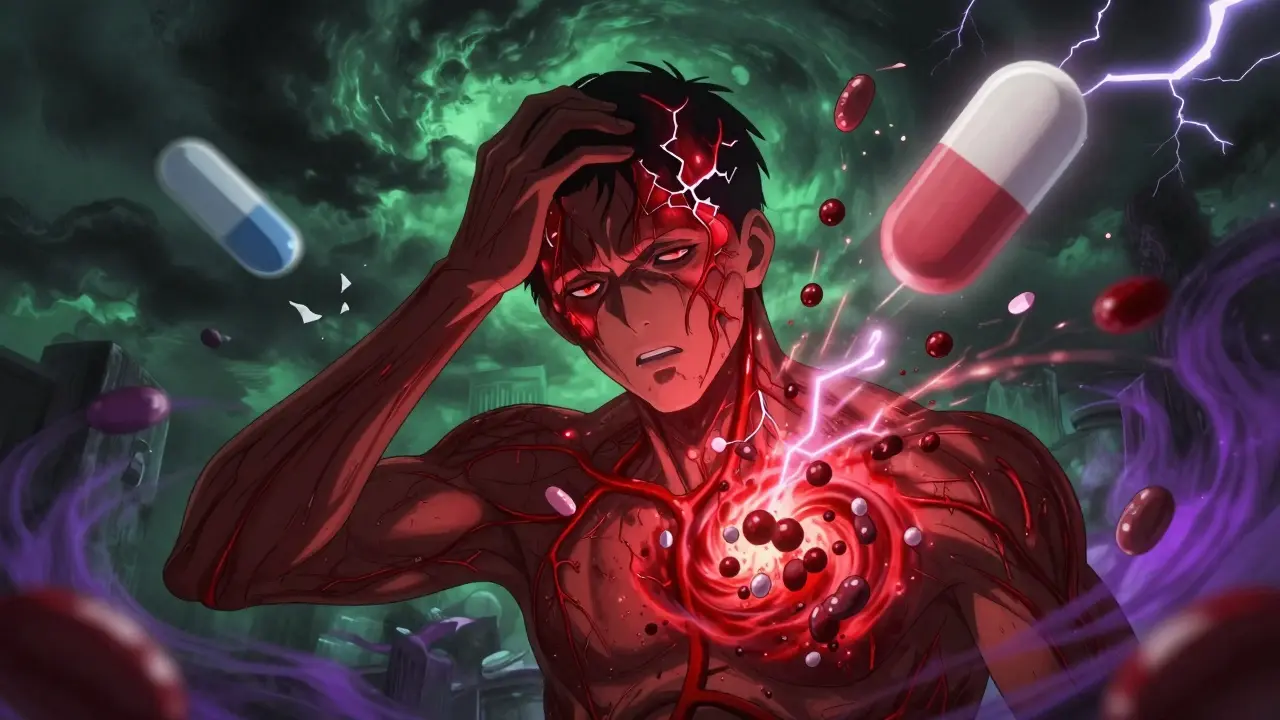
Ephedrine is a stimulant. It’s in some cold and asthma meds, energy supplements, and even weight-loss products. It works by forcing your body to release more norepinephrine, the chemical that raises your heart rate and blood pressure. MAOIs-like phenelzine, tranylcypromine, or isocarboxazid-are antidepressants that stop your body from breaking down norepinephrine, serotonin, and dopamine. Together, they create a perfect storm: norepinephrine floods your system, and there’s no way for your body to clean it up.The result? A hypertensive crisis. Blood pressure can spike from normal to over 200 mmHg systolic in under an hour. That’s not just high blood pressure. That’s a medical emergency. Your blood vessels rupture. Your brain bleeds. Your heart struggles. And it happens quickly-often within 30 to 120 minutes after taking even a small dose of ephedrine.
The Real-World Cost of This Interaction
This isn’t theoretical. It’s been documented in hospitals, emergency rooms, and coroners’ reports for over 60 years. In 1965, a 49-year-old woman took a single 25 mg dose of ephedrine while on nialamide, an MAOI. Within 30 minutes, she collapsed. A CT scan showed a subarachnoid hemorrhage. She died. That case was published in JAMA. It wasn’t an outlier.In 2018, a 32-year-old man on phenelzine took a 25 mg ephedrine tablet for a stuffy nose. His blood pressure hit 240 mmHg. He suffered a brain bleed. He survived, but barely. His story was published in the Journal of Clinical Psychopharmacology. And it’s not just prescription MAOIs. People on selegiline patches, even at low doses, have had similar reactions.
Reddit threads from people on MAOIs are full of terrifying accounts: ‘My vision went white,’ one user wrote in 2022. ‘I felt like my head was going to explode.’ Another described vomiting, sweating, and chest pain so tight it felt like a band was crushing their ribs. These aren’t exaggerations. They’re clinical symptoms of a body drowning in its own chemicals.
How Much Ephedrine Is Dangerous?
You might think, ‘I only took half a pill.’ But here’s the scary part: as little as 12.5 mg of ephedrine can trigger a crisis in someone on an MAOI. That’s less than the amount in some OTC cold tablets, which often contain 25 to 120 mg per dose. Pseudoephedrine, phenylephrine, and phenylpropanolamine-common decongestants-carry the same risk. They all act like ephedrine in this context.And it’s not just about the dose. It’s about timing. If you stop an MAOI, you’re not safe after a few days. Irreversible MAOIs like Nardil or Parnate permanently disable the enzyme. It takes two to three weeks for your body to make new ones. So even if you stopped your antidepressant last week, taking a cold medicine now could still be deadly.
Why Do Doctors Still Prescribe MAOIs?
MAOIs make up less than 1% of antidepressant prescriptions today. SSRIs and SNRIs are safer, easier to use, and have fewer side effects. So why are they still around?Because for some people, they work when nothing else does. If you’ve tried four or five antidepressants and still feel hopeless, MAOIs can be the only thing that brings relief. They’re especially effective for atypical depression-where you feel heavy, oversleep, overeat, and are hypersensitive to rejection. In those cases, the risk might be worth it. But only if you’re under strict supervision.
The FDA requires every MAOI prescription to come with a medication guide. It lists every drug you can’t take. It warns about foods like aged cheese and red wine. And it screams about ephedrine and other stimulants. But studies show 22% of people on MAOIs still get prescribed a contraindicated drug within 30 days. Often, it’s a primary care doctor who doesn’t know the risks.
What to Do If You’re on an MAOI
If you’re taking an MAOI, here’s your non-negotiable checklist:- Avoid all OTC cold, flu, and allergy meds. Read every label. If it says ‘decongestant,’ ‘stimulant,’ or ‘for sinus congestion,’ put it down.
- Check every supplement. Some weight-loss pills, pre-workouts, and energy boosters contain ephedrine or similar compounds. Even ‘natural’ ones.
- Carry an MAOI alert card. The Mayo Clinic found that 87% of patients who carried one avoided dangerous interactions. Keep it in your wallet. Put it in your phone. Tell your pharmacist, your dentist, your ER doctor.
- Wait at least 14 days after stopping an irreversible MAOI before taking any stimulant. For reversible MAOIs like moclobemide, 48 hours is usually enough-but only if you’re sure you’re on the right one.
- Never take ephedrine, pseudoephedrine, or phenylephrine-even if you think ‘it’s just a little.’ There’s no safe dose.
What If You Accidentally Take Them Together?
If you’ve taken ephedrine while on an MAOI and you feel:- A sudden, severe headache-especially at the back of your head
- Blurred vision or seeing spots
- Chest pain or tightness
- Palpitations, sweating, nausea, or vomiting
Call 999 immediately. Do not wait. Do not drive yourself. This is not a ‘wait and see’ situation.
Emergency teams will give you intravenous phentolamine to lower your blood pressure fast. They will NOT give you sublingual nifedipine. That’s a common mistake-and it can cause your blood pressure to crash too fast, leading to stroke or heart attack.
The Future: Are MAOIs Becoming Obsolete?
Some experts say yes. Between 2000 and 2020, 127 people died from MAOI drug interactions. That’s more than the number of deaths from all other antidepressant interactions combined. Dr. David Healy argues MAOIs should be pulled from the market entirely-except for research.Others say no. A new reversible MAOI called befloxatone was approved by the FDA in March 2023. Early data shows it’s 90% less likely to cause a hypertensive crisis because it wears off in just six hours. Researchers are also testing wearable blood pressure monitors that can alert patients before a crisis hits.
But for now, the rules haven’t changed. If you’re on an MAOI, ephedrine is poison. And if you’re taking a cold medicine, you need to know whether the person next to you is on an antidepressant that could turn that pill into a death sentence.
Who’s at Risk? You Might Not Think It’s You
You might think, ‘I don’t take MAOIs. This doesn’t apply to me.’ But here’s the thing: your friend, your parent, your coworker might. They might be on one because nothing else worked. They might be too embarrassed to tell you. They might not even know the name of their drug-just that it’s ‘the one that helps me feel human again.’And if they take a decongestant because they’re sick? They might not survive the night.
This isn’t about being careful. It’s about being informed. It’s about asking: ‘What’s in this pill?’ before you take it. It’s about checking with your pharmacist, even if you’ve taken it before. It’s about knowing that in medicine, some combinations aren’t just risky-they’re lethal.
Can I take Sudafed if I’m on an MAOI?
No. Sudafed contains pseudoephedrine, which acts just like ephedrine in this interaction. It can trigger a hypertensive crisis even at normal doses. Never take any decongestant-whether it’s pseudoephedrine, phenylephrine, or phenylpropanolamine-while on an MAOI.
How long after stopping an MAOI is it safe to take ephedrine?
For irreversible MAOIs like Nardil or Parnate, you must wait at least 14 days-some experts recommend 21 days. For reversible MAOIs like moclobemide, 48 hours is usually sufficient. But if you’re unsure which one you took, wait two weeks. The risk isn’t worth guessing.
Are all MAOIs equally dangerous with ephedrine?
No, but the difference is small. Irreversible MAOIs (phenelzine, tranylcypromine, isocarboxazid) are the most dangerous because they permanently disable the enzyme. Selegiline patches at low doses (6 mg/24hr) carry lower risk, but it’s still there. Even the newer reversible MAOIs like befloxatone aren’t risk-free-just less risky. Always assume the interaction is dangerous unless proven otherwise.
What should I do if I’m prescribed an MAOI?
Ask for a complete list of contraindicated drugs and foods. Get an MAOI alert card from your pharmacist. Show it to every doctor, dentist, or ER provider before any procedure or medication. Never assume someone else knows about this interaction-even if they’re a specialist. This is one of the most lethal drug interactions in medicine.
Can I use herbal supplements like ephedra if I’m on an MAOI?
No. Ephedra is a natural source of ephedrine. Even if it’s labeled ‘herbal’ or ‘natural,’ it’s chemically identical to synthetic ephedrine. The FDA banned ephedra in dietary supplements in 2004 because of its danger, but some products still slip through. If it says ‘ephedra,’ ‘ma huang,’ or ‘stimulant,’ avoid it completely.
What are the early warning signs of a hypertensive crisis?
The first sign is often a sudden, severe headache-usually at the back of the head, radiating forward. Other signs include vision changes (blurred or white spots), chest tightness, rapid heartbeat, nausea, sweating, and extreme anxiety. If you’re on an MAOI and feel any of these after taking a cold medicine, seek emergency help immediately.
Final Thought: This Isn’t a Warning. It’s a Lifesaver.
This interaction isn’t rare. It’s predictable. It’s preventable. And every year, people die because they didn’t know. You might think it won’t happen to you. But if you’re taking an MAOI-or if someone you care about is-this knowledge could be the only thing that keeps them alive.Read the label. Ask the pharmacist. Speak up. Because sometimes, the difference between life and death is knowing what’s in a pill you thought was harmless.


I am a pharmaceutical expert with over 20 years of experience in the industry. I am passionate about bringing awareness and education on the importance of medications and supplements in managing diseases. In my spare time, I love to write and share insights about the latest advancements and trends in pharmaceuticals. My goal is to make complex medical information accessible to everyone.