

Many people assume that if a generic drug is approved, it might be significantly weaker-or stronger-than the brand-name version. You’ve probably heard the myth: generic drugs can contain 80% to 125% of the active ingredient compared to the brand. That’s not just misleading-it’s flat-out wrong. The 80-125% rule doesn’t refer to how much drug is in the pill. It’s about how fast and how completely your body absorbs it. And the truth? It’s far more precise than most people think.
What the 80-125% Rule Actually Measures
The 80-125% range isn’t about the amount of medicine in the tablet. It’s about bioequivalence-how your body handles the drug after you take it. The U.S. Food and Drug Administration (FDA) uses this range to decide whether a generic drug performs the same way in your body as the original brand-name version. Two key measurements are used: AUC (area under the curve), which tells you how much of the drug enters your bloodstream over time, and Cmax, which shows how quickly it gets there.
Here’s the catch: the FDA doesn’t just look at the average numbers. They require the 90% confidence interval of the ratio between the generic and brand drug to fall entirely within 80-125%. That’s a statistical safety net. It means that even accounting for natural differences between people, the real difference in absorption is almost certainly tiny.
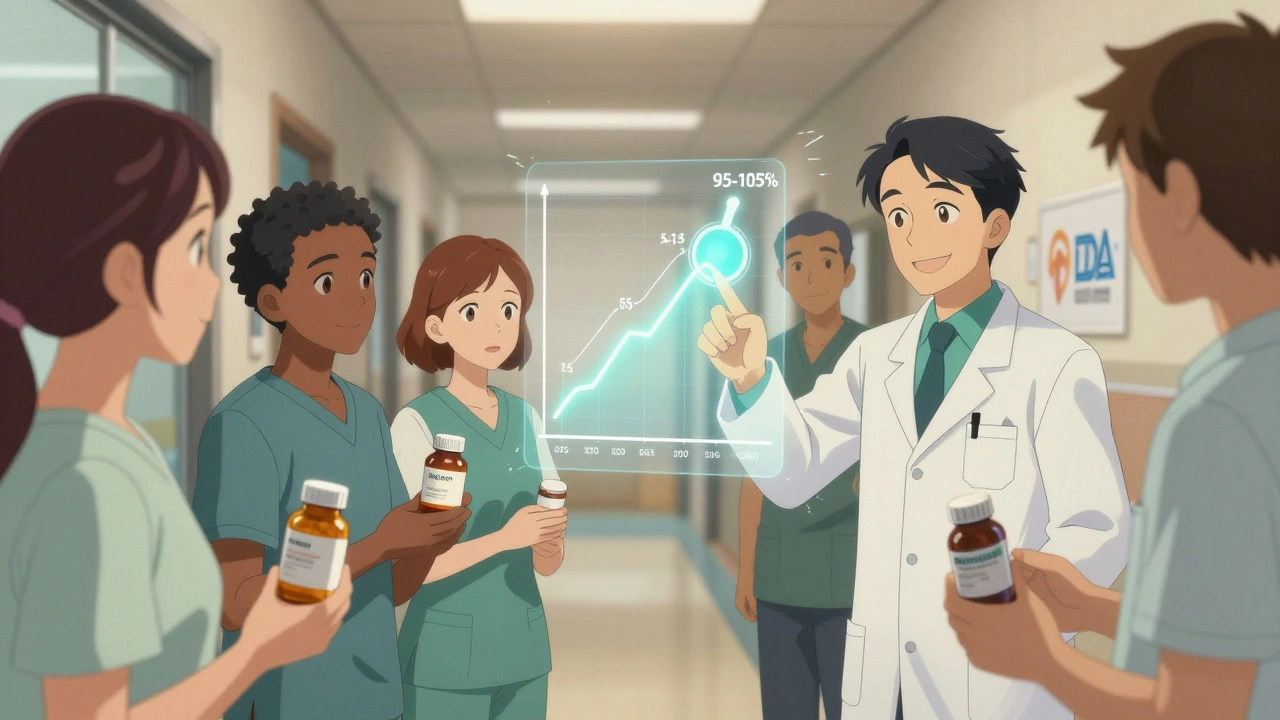
For example, if the brand drug delivers an AUC of 100 units, a generic with a point estimate of 90 units might still pass if its 90% confidence interval is 83-97. But if the point estimate is 85 and the interval dips to 78-92, it fails-because part of that range falls below 80. In practice, the FDA found that 98% of approved generics had absorption rates between 95% and 105% of the brand. So the 80-125% rule isn’t a wide-open loophole-it’s a very tight filter.
Why 80-125% and Not 90-110%?
It seems odd that the range isn’t symmetrical. Why not 80-120%? Or 90-110%? The answer lies in how drug absorption data behaves. Blood concentration levels after taking a pill don’t follow a normal bell curve-they follow a log-normal distribution. That means the math has to be done on the logarithmic scale.
When scientists take the natural log of 0.80, they get -0.223. When they take the log of 1.25, they get +0.223. That’s symmetrical around zero (which represents 100%). So the 80-125% range is actually a 20% variation on a log scale, not a linear one. If they used 80-120%, they’d be treating the data incorrectly. The 80-125% range was chosen because it’s statistically valid for this type of biological data.
This isn’t arbitrary-it’s based on decades of research. The FDA adopted this standard in 1992 after reviewing hundreds of studies. Even the European Medicines Agency (EMA) and Health Canada use the same range. It’s not just American policy-it’s global science.
What About Dangerous Drugs Like Warfarin?
Not all drugs are created equal. For drugs with a narrow therapeutic index-where even a small change in blood level can cause harm or reduce effectiveness-the rules get stricter. Warfarin (a blood thinner), levothyroxine (for thyroid disease), and some epilepsy medications fall into this category.
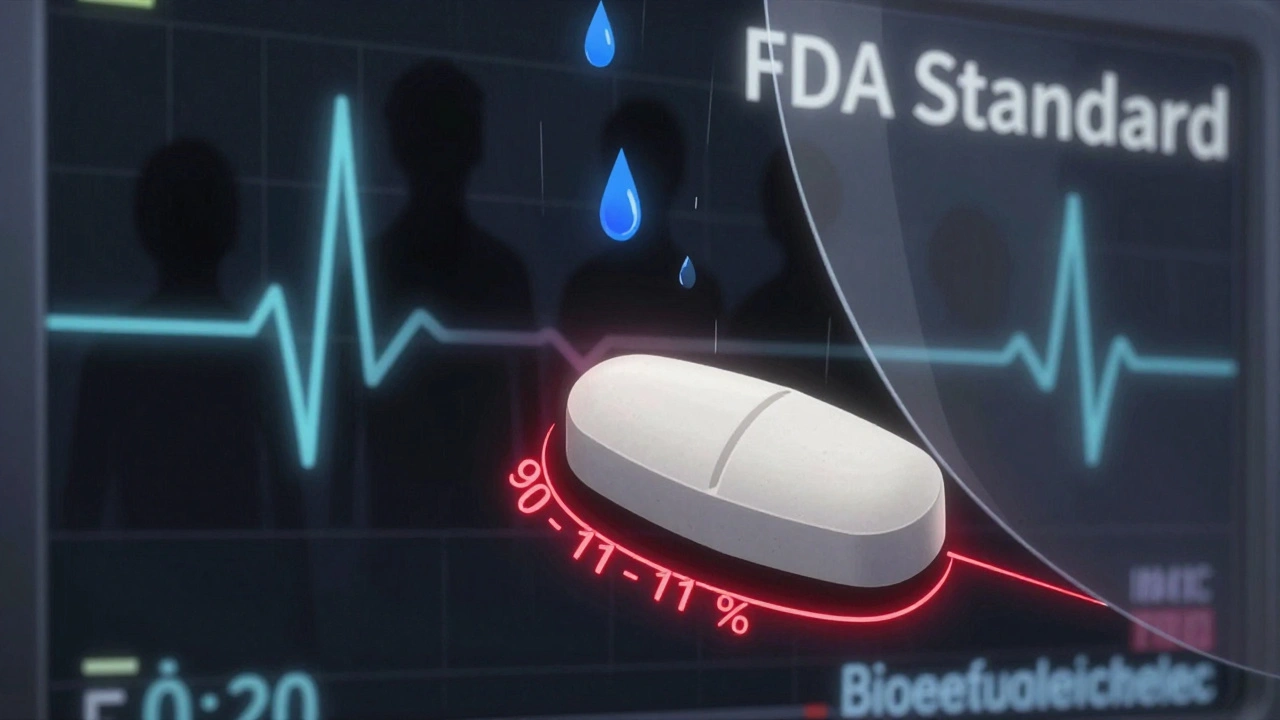
For these, the FDA requires a tighter range: 90-111%. That’s a 21% window instead of 45%. Why? Because with these drugs, a 10% difference in absorption could mean a stroke-or a seizure. The FDA doesn’t treat them the same as a generic ibuprofen. In fact, they’ve published specific guidance for each of these high-risk drugs, requiring more rigorous testing, sometimes with multiple dosing cycles and even patient outcome studies.
And it works. A 2016 study in JAMA Internal Medicine tracked over 2 million patients on generic vs. brand cardiovascular drugs. No difference in heart attacks, strokes, or hospitalizations. The same goes for thyroid medication-patients switching from brand to generic didn’t show worse outcomes, even though their hormone levels are tightly monitored.
Why Do People Still Doubt Generics?
Despite all the data, myths persist. Pharmacy students on forums like Student Doctor Network still think generics can be 25% weaker. Patients on Reddit worry they’re getting “cheap” medicine. Even some doctors aren’t fully up to speed.
The problem? The numbers sound scary. “80-125%” looks like a huge range. But as the FDA’s Dr. Shiew Mei Huang said, “That’s not what it means.” It’s a statistical boundary, not a license for variation. The real-world difference between brand and generic is usually under 5%. In fact, FDA analysis of over 2,000 studies found the average difference was just 3.5%.
Pharmacists are on the front lines. A 2020 survey found 78% of U.S. pharmacists explain bioequivalence to patients at least once a week. And when they do? 63% say patient concerns vanish. The FDA’s #GenericsWork campaign, with over a million social media views, is trying to fix this. But misinformation spreads faster than facts.
How Are These Studies Done?
Before a generic hits the market, it goes through a bioequivalence study. Usually, 24 to 36 healthy volunteers take both the brand and generic versions in a crossover design-some get the brand first, others the generic. Blood samples are taken every 15 to 30 minutes for up to 72 hours. The data is plotted into concentration-time curves.
The lab must be precise. Analytical methods must be accurate within 15% error. The study design follows strict FDA guidelines. If the drug has high variability-meaning people’s absorption levels bounce around a lot-researchers use replicate designs, where each person takes each version multiple times. That’s more expensive, but necessary for accuracy.
And it’s not just about pills. For inhalers, topical creams, or injectables, the rules are even more complex. The FDA has special guidance for each type. For example, with inhalers, they look at lung deposition, not just blood levels. With creams, they test skin absorption. The 80-125% rule applies to oral tablets-but other delivery methods need different tools.
What Does This Mean for You?
If you’re taking a generic drug, you’re getting the same medicine. The active ingredient is identical. The absorption rate is nearly identical. The clinical outcomes? Identical.
That’s why 90% of U.S. prescriptions are filled with generics. They save patients and the healthcare system billions. In 2021 alone, generics saved $373 billion in the U.S. That’s not just a cost savings-it’s access. Without generics, millions couldn’t afford their medications.
There are rare cases where someone might feel different switching brands. Sometimes it’s the fillers, the coating, or even the size of the pill. But that’s not bioequivalence failure-it’s individual sensitivity. If you notice a change, talk to your doctor or pharmacist. But don’t assume the generic is inferior.
And if you’re prescribed a high-risk drug like warfarin? Your doctor will monitor you closely, regardless of whether it’s brand or generic. That’s standard care-not a red flag.
What’s Next for Generic Drugs?
The FDA is moving toward more tailored approaches. By 2025, they plan to use computer modeling and “model-informed drug development” to predict how a generic will behave-especially for complex drugs like biologics or long-acting injections. But the 80-125% rule isn’t going anywhere. It’s been tested for over 30 years, validated by millions of prescriptions, and upheld by courts.
In 2022, the U.S. Supreme Court affirmed the FDA’s authority in a case involving Mylan’s generic drugs. Justice Kavanaugh wrote that the FDA’s standards “have withstood three decades of real-world testing.” That’s not just legal backing-it’s proof that science works.
Generics aren’t second-rate. They’re scientifically validated, cost-effective, and just as safe. The 80-125% rule isn’t a loophole-it’s a guarantee. And if you’ve ever wondered whether your generic pill is “good enough,” the answer is yes. It’s not just good enough. It’s proven.
Does the 80-125% rule mean generic drugs can have 25% less active ingredient?
No. The 80-125% rule refers to the rate and extent of absorption into your bloodstream-not the amount of active ingredient in the pill. All generic drugs must contain the same active ingredient, in the same strength, as the brand-name version. The rule ensures your body absorbs it similarly, not that the pill contains less or more drug.
Are generic drugs less effective than brand-name drugs?
No. Large studies, including one analyzing 2 million patient records in JAMA Internal Medicine, show no difference in clinical outcomes between brand and generic drugs for conditions like high blood pressure, cholesterol, and thyroid disease. The FDA requires bioequivalence testing to prove they work the same way in your body.
Why do some people say they feel different on a generic?
Sometimes, differences in inactive ingredients-like fillers, dyes, or coatings-can affect how a pill tastes, dissolves, or feels in the stomach. Rarely, this can cause minor side effects like nausea or bloating. But these aren’t signs the drug doesn’t work. If you notice a change, talk to your pharmacist. They can check if it’s the formulation or suggest another generic version.
Is the 80-125% rule used worldwide?
Yes. The European Medicines Agency (EMA), Health Canada, and over 50 other countries use the same 80-125% bioequivalence standard. It’s not just an American rule-it’s the global scientific consensus for ensuring generic drugs are therapeutically equivalent.
Are all generic drugs tested the same way?
Most oral tablets follow the standard 80-125% rule using blood tests. But for complex drugs like inhalers, creams, or injectables, the testing changes. For example, inhalers are tested for lung delivery, and topical creams for skin absorption. The FDA has specific guidelines for each drug type, and the approval process is tailored accordingly.
Can I trust a generic drug for a serious condition like epilepsy or heart disease?
Yes. For drugs with narrow therapeutic indexes-like those for epilepsy, thyroid disease, or blood thinning-the FDA uses stricter standards (90-111%) and often requires additional testing. Real-world data shows no increase in seizures, strokes, or hospitalizations when switching to approved generics. If your doctor recommends a generic, it’s because it’s been proven safe and effective.


I am a pharmaceutical expert with over 20 years of experience in the industry. I am passionate about bringing awareness and education on the importance of medications and supplements in managing diseases. In my spare time, I love to write and share insights about the latest advancements and trends in pharmaceuticals. My goal is to make complex medical information accessible to everyone.