

When you or someone you care about has asthma, an inhaler can mean the difference between breathing easily and struggling for air. But not all inhalers are the same. Two types dominate asthma treatment: rescue inhalers and maintenance inhalers. They look similar, often come in the same color, and are held the same way. Yet using one instead of the other can be dangerous - even life-threatening.
What Rescue Inhalers Do (and Don’t Do)
Rescue inhalers are your emergency tool. They kick in within seconds when you’re wheezing, coughing, or feeling tightness in your chest. These are short-acting beta agonists (SABAs), and their active ingredients are usually albuterol (sold as Ventolin, ProAir, Proventil) or levalbuterol (Xopenex). They work by relaxing the muscles around your airways, letting them open up fast. You’ll feel relief in 1 to 5 minutes, and it lasts about 4 to 6 hours.
But here’s the catch: rescue inhalers don’t touch the root cause of asthma. They don’t reduce swelling or mucus in your lungs. They just give you a quick fix. That’s why using one every day - even if you feel better - is a red flag. If you’re reaching for your rescue inhaler more than twice a week, your asthma isn’t under control. You’re treating symptoms, not the disease.
Proper technique matters. Breathe in slowly for 5 to 7 seconds, then hold your breath for 10. Do that right, and about 30-40% of the medicine reaches your lungs. Do it wrong? You might only get 10-15%. That’s like half your dose vanishing into the air.
What Maintenance Inhalers Are For
Maintenance inhalers are the quiet backbone of asthma management. You don’t notice them working - because they’re not meant to give you instant relief. They’re designed to prevent attacks before they start. These contain either inhaled corticosteroids (like fluticasone or budesonide) or long-acting beta agonists (like formoterol or salmeterol), often in combination.
These medications fight inflammation - the real problem in asthma. It takes 24 to 48 hours for them to even begin working. Maximum benefit? That takes 1 to 3 weeks of daily use. Missing a day here and there might not feel like a big deal, but research shows skipping just 20% of your doses (about 3 out of 15 weekly puffs) cuts effectiveness by 45%.
Studies back this up. A 2022 Cochrane Review of over 15,000 patients found that consistent use of maintenance inhalers reduces asthma flare-ups by 40-60% compared to no treatment. That’s not small. It’s the difference between missing work or school and staying active.
Some inhalers, like Symbicort (budesonide + formoterol) and Advair (fluticasone + salmeterol), combine both types of drugs. But here’s where confusion creeps in: Symbicort is now approved for both daily maintenance and as-needed rescue use - but only under specific guidelines. That doesn’t mean you can swap it for your albuterol inhaler. If you’re using it as rescue, you need to follow the exact dosing rules. Otherwise, you risk under-treating an attack.
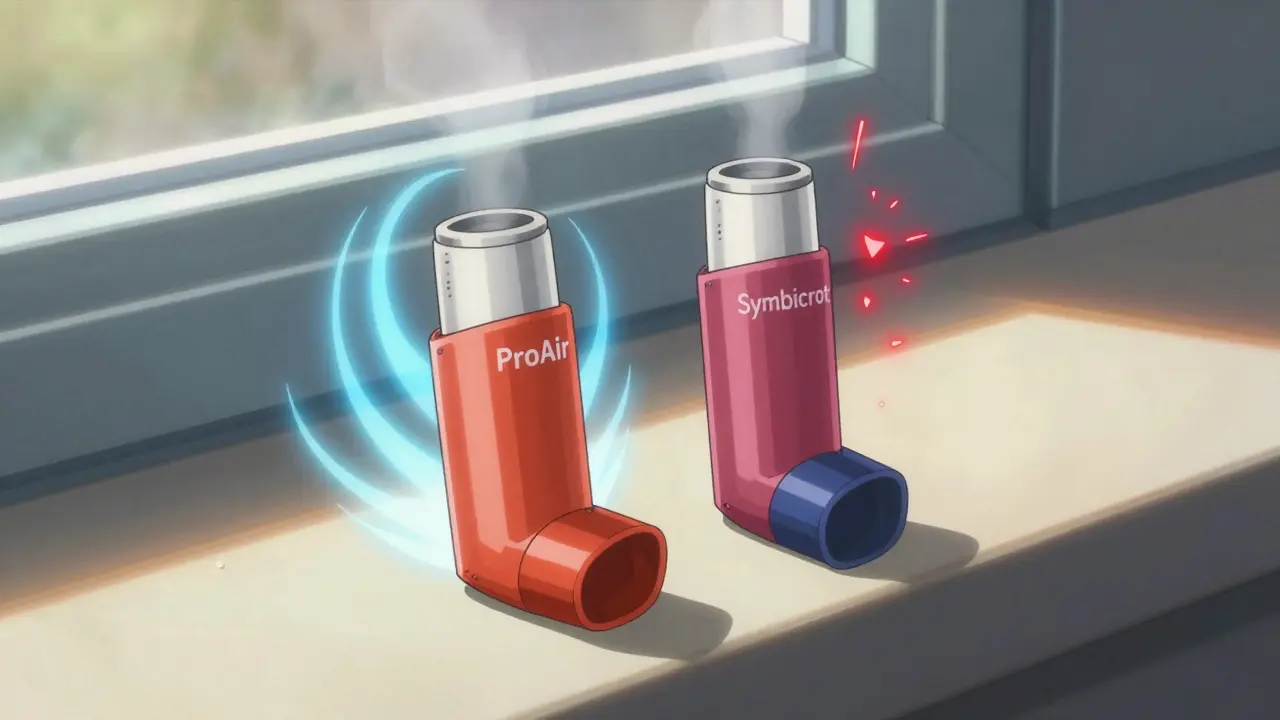
The Danger of Mixing Them Up
It sounds simple - use the red one for emergencies, the blue one every day. But in real life, it’s not that easy.
In June 2023, a 9-year-old boy at summer camp had an asthma attack. He grabbed his red inhaler - the one he’d been told to use. But it wasn’t his rescue inhaler. It was Symbicort, his maintenance inhaler. He used it like he always did - one puff. He waited. Nothing happened. Twelve minutes passed before someone realized the mistake. By then, his breathing had worsened. He ended up in the ER.
This isn’t rare. The Institute for Safe Medication Practices logged 1,247 cases of inhaler mix-ups in 2022 alone. The American College of Allergy, Asthma & Immunology found that 38% of near-fatal asthma cases involved people relying only on rescue inhalers, skipping their daily controller. Meanwhile, patients who used maintenance inhalers correctly cut their ER visits by over 60%.
Even doctors warn about this. Dr. Emily Mendez, a leading asthma specialist, says confusing these inhalers is one of the top five preventable causes of hospitalizations in kids. And it’s not just children. On Reddit’s r/asthma community, users share stories of using Symbicort like albuterol for months before realizing their asthma was spiraling out of control.
Color Coding, Storage, and What’s Changing
Since 2023, the FDA has required new inhalers to use clear color codes: red for rescue, blue or white for maintenance. But millions of older inhalers are still in use. So don’t trust the color. Read the label. Know the name.
Store both types below 30°C (86°F). Heat can break down the medicine. Keep them away from direct sunlight. Rescue inhalers last about 12 months after opening. Maintenance inhalers vary - some 3 months, others 6 - depending on the formulation. Check the box.
And here’s a shift you should know about: the Global Initiative for Asthma (GINA) now recommends single-inhaler therapy for many patients. For moderate to severe asthma, using a combination inhaler like Symbicort for both daily control and as-needed relief is becoming standard. This reduces confusion, cuts errors, and improves outcomes. By 2027, experts predict 60% of new asthma patients will start on this single-inhaler approach.

When to Call Your Doctor
Here’s a simple rule: if you’re using your rescue inhaler more than twice a week (not counting exercise), your asthma isn’t controlled. That’s your signal to talk to your provider. You might need a maintenance inhaler, or your dose might need adjusting.
Also, if you’ve used your rescue inhaler more than 12 times in a month, you’re at higher risk of a serious attack. A 2024 Express Scripts study found that patients who started using phone reminders to take their maintenance inhaler saw their rescue use drop from 18.7 times per month to 4.3 - all within three months.
Cost is a barrier. A rescue inhaler like generic ProAir costs $35-$50 without insurance. A maintenance inhaler like Symbicort can run $300-$350 a month. Forty-two percent of patients skip doses because they can’t afford them. Talk to your doctor about generics, patient assistance programs, or switching to a single-inhaler option that may be more cost-effective long-term.
What You Need to Remember
- Rescue inhalers = emergency use only. They’re fast, but they don’t fix the problem.
- Maintenance inhalers = daily use. They take time, but they prevent attacks.
- Never use a maintenance inhaler during an acute attack - it won’t work fast enough.
- Always check the label, not just the color.
- More than 2 rescue puffs a week? Call your doctor.
- Single-inhaler therapy (like Symbicort for both) is now recommended for many - ask if it’s right for you.
Asthma doesn’t have to control your life. But it demands respect. Knowing which inhaler does what - and using them correctly - saves lives.


I am a pharmaceutical expert with over 20 years of experience in the industry. I am passionate about bringing awareness and education on the importance of medications and supplements in managing diseases. In my spare time, I love to write and share insights about the latest advancements and trends in pharmaceuticals. My goal is to make complex medical information accessible to everyone.