
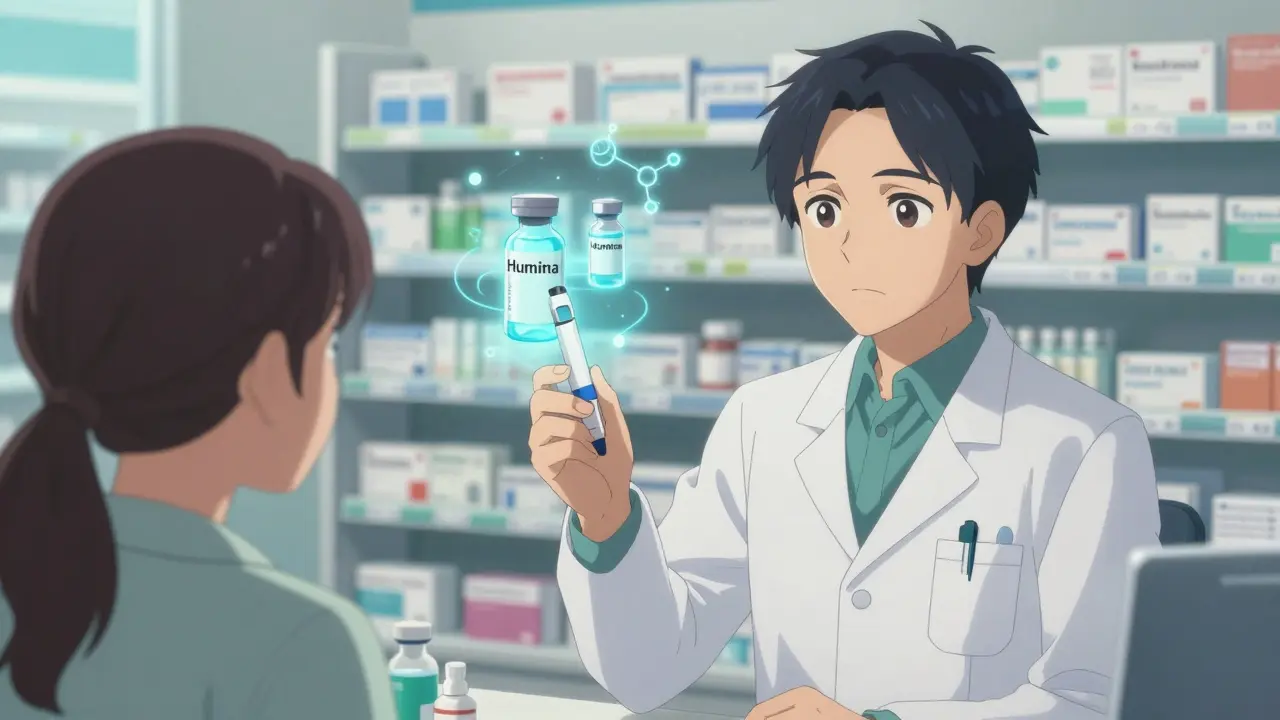
When a patient walks into the pharmacy with a prescription for a biologic drug like Humira or Enbrel, they’re not just getting a pill. They’re getting a complex, expensive therapy made from living cells - and chances are, the pharmacist is about to hand them a biosimilar instead. This isn’t guesswork. It’s science. And it’s changing how care is delivered, one conversation at a time.
What Makes Biosimilars Different From Generics?
People often assume biosimilars are just like generic drugs. They’re not. Generics are exact chemical copies of small-molecule drugs - think ibuprofen or metformin. Their structure is simple, and manufacturing is predictable. Biosimilars, on the other hand, are copies of large, complex proteins made from living cells. Even tiny changes in the manufacturing process - temperature, pH, cell line - can lead to minor structural differences. That’s why the FDA doesn’t call them “identical.” They call them “highly similar,” with no clinically meaningful differences in safety, purity, or effectiveness. The approval path for biosimilars is also different. The Biologics Price Competition and Innovation Act (BPCIA) of 2009 created a special pathway for them, requiring extensive testing but not full-scale clinical trials like the original. Still, the bar is high. To be approved as interchangeable, a biosimilar must prove that switching back and forth between it and the original biologic doesn’t increase risk or reduce effectiveness. As of late 2023, only a handful of biosimilars in the U.S. have that designation - but the number is growing.Why Pharmacists Are the Key to Adoption
Biologics make up just 2% of all prescriptions in the U.S., yet they account for nearly half of all prescription drug spending. That’s a massive financial burden on patients and the system. Biosimilars can cut those costs by 15% to 35%, sometimes more. But cost alone doesn’t drive adoption. Trust does. Physicians often hesitate. Patients are nervous. Many believe switching to a biosimilar is like switching from a branded painkiller to a generic - but it’s not. They worry about safety, effectiveness, or even side effects. That’s where pharmacists come in. Research from the US Oncology Network showed that when pharmacists took the lead in switching patients to biosimilars - not doctors - adoption jumped dramatically. For pegfilgrastim (Neulasta), biosimilar use went from almost zero to over 80% in just months after pharmacists began handling substitutions automatically. Why? Because pharmacists are the last point of contact before the patient takes the medicine. They have the time, training, and authority to explain, reassure, and document. A 2022 study found that 87% of pharmacists recommended biosimilars to patients, compared to just 62% of physicians. Why the gap? Pharmacists are more likely to get continuing education on biosimilars - 79% have taken training, versus 43% of doctors. They’re also the ones who answer questions like: “Is this the same?” “Will it work as well?” “What if I switch back?”How Substitution Works - And When It Doesn’t
In most states, pharmacists can substitute a generic drug without telling the prescriber. That’s not always true for biosimilars. State laws vary wildly. Some allow automatic substitution only if the product is designated as “interchangeable” by the FDA. Others require the prescriber to explicitly allow substitution. A few still require the patient to give written consent every time. The key is knowing your state’s rules. But even when the law allows substitution, it’s not automatic. Pharmacists must check:- Is the biosimilar FDA-approved as interchangeable?
- Has the prescriber marked “dispense as written”?
- Is the patient’s insurance covering the biosimilar?
- Has the patient been educated?
How to Counsel Patients - Without Scaring Them
Patient fear is the biggest barrier to biosimilar use. One Reddit user, a pharmacist in Texas, shared: “I tell patients, ‘The FDA doesn’t approve a biosimilar unless it works just like the original. No meaningful differences. Not even a tiny one.’ And most of them nod and say, ‘Okay, I’m good.’” Effective counseling isn’t about jargon. It’s about clarity. Here’s what works:- Start with facts: “This is a biosimilar to Humira. It’s been tested in thousands of patients and approved by the FDA as safe and effective.”
- Use analogies: “Think of it like two different brands of insulin. They’re made differently, but they do the same job.”
- Address appearance: “The pen might look different, or the liquid might be a different color. That doesn’t mean it’s less effective.”
- Highlight savings: “This version will save you hundreds a month. And your insurance will likely cover it better.”
What Happens When Things Go Wrong?
Not every substitution goes smoothly. Some prescribers push back hard. One doctor on a medical forum complained: “I got angry when my pharmacist switched my patient’s biologic without asking. Now I write ‘dispense as written’ on every biologic script.” That’s a red flag. It means communication broke down. The solution isn’t to stop substitution - it’s to improve collaboration. Best practices include:- Pharmacists notifying prescribers via EHR when a substitution occurs.
- Providing prescribers with clear, written policies on biosimilar use.
- Training all clinic staff - nurses, PAs, financial counselors - on biosimilar basics.

The Bigger Picture: Cost, Access, and the Future
The financial stakes are huge. Biologics are among the most expensive drugs on the market. A single year of Humira can cost over $20,000. A biosimilar version? Around $13,000. That’s a $7,000 saving per patient. Multiply that by thousands of patients, and you’re talking billions saved across the system. But cost isn’t the only win. Access is too. Many patients delay or skip biologics because they can’t afford them. Biosimilars open the door. And pharmacists are the ones who help them walk through it. Looking ahead, the FDA is considering simplifying the interchangeability designation process. Some experts believe it might disappear entirely. States are updating laws to make substitution easier. More biosimilars are coming - for insulin, TNF inhibitors, even monoclonal antibodies used in cancer. The role of the pharmacist isn’t changing. It’s expanding. We’re moving toward a future where pharmacists aren’t just dispensers - they’re clinical decision-makers, educators, and advocates for safer, more affordable care.What You Need to Know Right Now
If you’re a pharmacist working with biosimilars, here’s your checklist:- Know your state’s substitution laws - they’re not the same everywhere.
- Confirm whether the biosimilar is FDA-designated as interchangeable.
- Always check for “dispense as written” on the prescription.
- Document the product name and lot number in the EHR.
- Explain the switch clearly, calmly, and confidently to the patient.
- Offer educational materials - brochures, videos, or printed FAQs.
- Follow up if the patient reports side effects - even if they seem minor.
Can a pharmacist substitute a biosimilar without the doctor’s permission?
Only if the biosimilar is FDA-designated as interchangeable AND your state allows automatic substitution. Even then, the prescriber can write “dispense as written” on the prescription, which legally prevents substitution. Pharmacists must follow both federal guidelines and state laws.
Are biosimilars as safe as the original biologic?
Yes. The FDA requires biosimilars to show no clinically meaningful differences in safety, purity, or effectiveness compared to the reference product. Thousands of patients have used them, and long-term data continues to confirm their safety. Interchangeable biosimilars must also prove that switching back and forth doesn’t increase risk.
Why do some patients stop taking biosimilars?
The most common reason is fear - often fueled by misinformation or changes in appearance (like a different pen design or liquid color). Studies show patients are 21% more likely to discontinue use if the medication looks different. Clear, upfront counseling from pharmacists reduces this risk significantly.
Do biosimilars work for all the same conditions as the original?
Yes - through a process called “indication extrapolation.” If a biosimilar is proven effective for one condition, and the mechanism of action is the same, the FDA can approve it for other conditions the original biologic treats - even if direct studies weren’t done for all. This is supported by clinical data and regulatory science.
Why do pharmacists get more training on biosimilars than doctors?
Pharmacists are often the frontline for medication access and education. Many pharmacy schools and continuing education programs now include biosimilars as a core topic. Additionally, pharmacists are more likely to encounter patients who have questions at the counter, so they’re incentivized to stay updated. Studies show 79% of pharmacists have taken biosimilar training, compared to 43% of physicians.
If you’re a pharmacist, your role has never been more critical. You’re not just filling prescriptions - you’re removing barriers to care, saving money, and building trust. And that’s something no algorithm or AI can replace.


Hi, I'm Caden Lockhart, a pharmaceutical expert with years of experience in the industry. My passion lies in researching and developing new medications, as well as educating others about their proper use and potential side effects. I enjoy writing articles on various diseases, health supplements, and the latest treatment options available. In my free time, I love going on hikes, perusing scientific journals, and capturing the world through my lens. Through my work, I strive to make a positive impact on patients' lives and contribute to the advancement of medical science.