
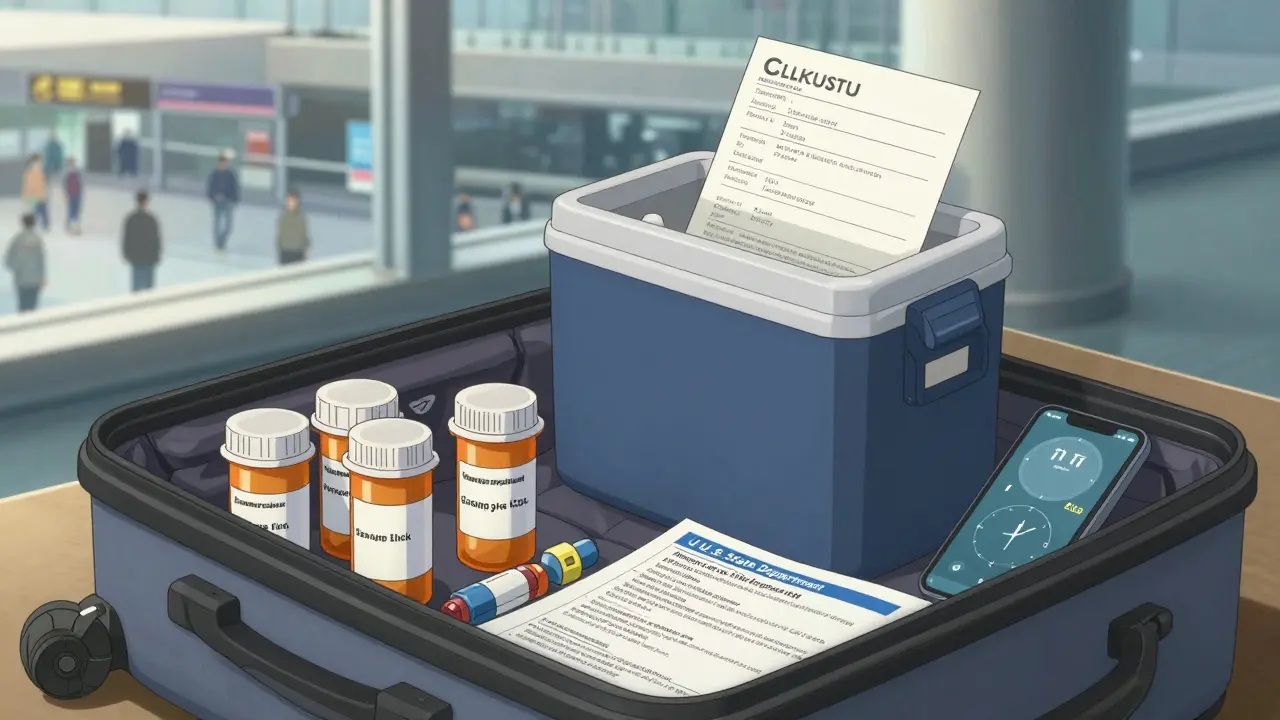
When you’re packing for a trip, you think about clothes, chargers, and maybe a good book. But if you take prescription or even over-the-counter meds daily, there’s one thing you can’t afford to forget: your medications. Skipping this step can lead to missed doses, ruined pills, legal trouble, or worse - a medical emergency in a country where no one speaks your language.
Half of all American adults take at least one prescription drug. That means if you’re traveling, chances are you’re carrying something that needs careful handling. And it’s not just about bringing enough pills. It’s about knowing what’s legal where you’re going, how to keep them from spoiling in the heat, and what to say when TSA asks you to open your bag.
Always Keep Meds in Original Containers
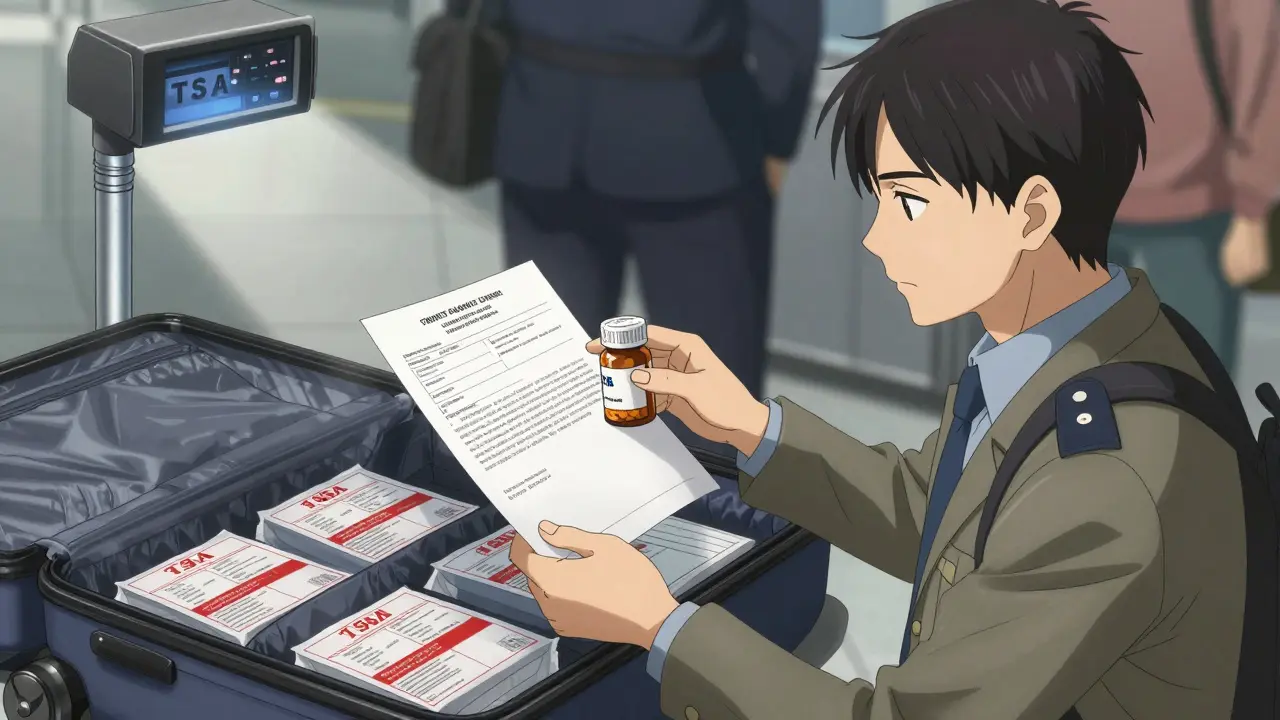
TSA and every major health organization - from the CDC to Harvard Global Support Services - agrees on this: never transfer pills to pill organizers or ziplock bags for travel. Keep them in their original pharmacy bottles with the label still attached. That label has your name, the doctor’s name, the drug name, and the dosage. It’s your proof that you’re not smuggling something illegal.
Why does this matter? In 2019, a Toyota executive was held for 23 days in Tokyo because she mailed herself a painkiller that’s banned in Japan. She had a U.S. prescription, but Japanese customs didn’t care. The label on the bottle was her only defense - and it wasn’t enough because the medication itself was illegal there. Labels aren’t just for show. They’re your legal shield.
Even for domestic flights, having the original container helps avoid delays. TSA agents don’t have time to guess what that unlabeled white pill is. If they can’t read the label, they’ll hold your bag, call a supervisor, and possibly confiscate it. Just keep it in the bottle. Simple.
Bring More Than You Think You Need
Flight delays happen. Baggage gets lost. Your rental car breaks down. Your hotel loses power. That’s why you need a buffer.
Northwestern University’s safety team recommends bringing at least a two-week extra supply of every medication you take. That’s not overkill - it’s insurance. If you’re on insulin, blood pressure meds, or anything that can’t be skipped, running out isn’t an option. Even if your trip is only five days, pack for 19 days.
And don’t count on refilling abroad. U.S. prescriptions don’t work overseas. Most countries won’t refill them, and even if they do, the pharmacy might not carry the exact brand or dosage. The CDC is clear: you can’t ship meds to yourself from home, and foreign pharmacies can’t legally refill your U.S. prescription. Plan ahead. Call your pharmacy at least two weeks before you leave. Most insurance plans let you refill early - usually five days ahead. Use that window.
Check the Laws of Every Country You’re Visiting
Just because a drug is legal in the U.S. doesn’t mean it’s legal everywhere else. In fact, 67% of countries restrict at least one common American medication.
Here’s what’s banned or tightly controlled in places you might visit:
- Adderall, Ritalin - Illegal in Japan, Singapore, and South Korea. Even with a prescription, you can be detained.
- Ambien - Banned in Germany, Sweden, and the UAE.
- Sudafed (pseudoephedrine) - Restricted in 28 countries, including Australia and Canada. It’s used to make meth, so they’re strict.
- Codeine - Controlled in over 40 countries. Even cough syrup with codeine can get you in trouble in Dubai or Thailand.
- Hormone therapies - Some countries treat them like controlled substances. Bring documentation.
Don’t guess. Use the U.S. State Department’s Medication Check Tool - it’s free, updated in March 2023, and works for all 195 countries. Type in your medication name, and it tells you if it’s allowed, restricted, or banned. Print the results. Carry them with your prescriptions.
Know How to Handle Liquids, Injectables, and Refrigerated Meds
TSA lets you bring liquid medications in amounts larger than 3.4 ounces - but only if you tell them. Declare them at the checkpoint. Put them in a separate clear plastic bag. Don’t hide them. If you do, you’ll get pulled aside, and your bag will be searched. It’s not a big deal if you’re upfront.
For insulin, EpiPens, or anything that needs cold storage: use a small cooler with a pharmaceutical-grade cooling pack. These maintain 36°F to 46°F (2°C to 8°C) for over 48 hours. Don’t rely on hotel fridges - they can break. Don’t leave it in the car. Heat kills insulin. A 2023 IDDP Pharmacy report showed 12% of travelers lost insulin effectiveness because they left it in a hot rental car.
For injectables like insulin or B12 shots, carry a letter from your doctor explaining why you need them. Some countries require this even if the drug is legal. A simple note - signed and on letterhead - says: “Patient requires daily insulin injections for Type 1 diabetes. Prescribed by Dr. [Name], License # [Number].” Keep it in your wallet or travel kit.
Adjust for Time Zones - But Don’t Double Up
Time zone changes mess with your schedule. If you take a pill every 12 hours, and you fly across three zones, do you take it at 8 a.m. your time or 11 a.m. local time?
WebMD says it’s usually safe to take your dose 1-2 hours early or late. Don’t skip it. Don’t double up. That’s how you get side effects - nausea, dizziness, heart palpitations.
Set alarms on your phone for both your home time and destination time. For example: if you take a pill at 8 a.m. EST and land in London (5 hours ahead), set two alarms: one for 8 a.m. EST (which is 1 p.m. London time) and one for 8 a.m. London time. That way, you don’t accidentally skip a dose or take two in one day.
People who travel often say the hardest part isn’t the meds - it’s remembering when to take them. One Reddit user, u/HealthyTraveler99, got stuck in South Korean customs for 12 hours because they missed a dose of ADHD meds and panicked. They didn’t know the rules, and their body reacted badly. Don’t be that person.
Always Carry Meds in Your Carry-On
Never check your meds. Ever. Not even if your suitcase is full. The U.S. Customs and Border Protection says it clearly: “You should travel only with your own medication that was prescribed to you by a licensed physician and/or legally obtained in the United States.” And they mean it.
If your checked bag gets lost, you’re stranded. If it gets stolen, you’re out of pills. If the airline delays your flight by 12 hours, you’re out of time. Carry-on is the only safe option. Put your meds in a small, labeled pouch with your prescriptions, doctor’s letter, and printed country legality check.
Pro tip: Use a multi-dose pill organizer for daily use - but only if you keep the original bottles in your carry-on. The organizer is for convenience. The bottle is for proof.
Prepare for Side Effects and Emergencies
Travel stresses your body. Jet lag, dehydration, new foods, altitude changes - all of it can make side effects worse. If you’re on antidepressants, blood thinners, or thyroid meds, you might feel more tired, dizzy, or nauseous than usual.
Bring a small kit: electrolyte packets, anti-nausea pills (like Dramamine), and pain relievers (ibuprofen or acetaminophen). Check if those are allowed in your destination too. Don’t assume “it’s just Advil” is fine everywhere.
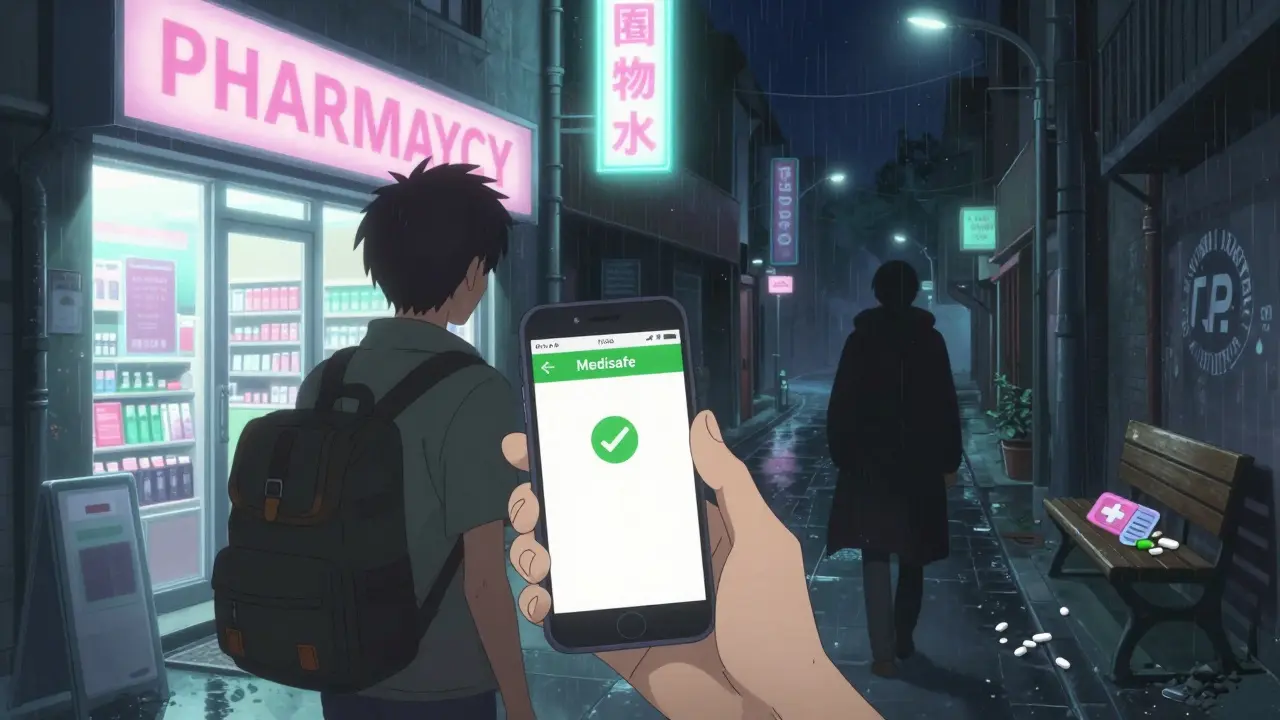
Also, know where the nearest pharmacy or clinic is at your destination. Google it before you land. Save the address in your phone. Some countries have pharmacies with English-speaking staff - especially in tourist areas. If you’re on a long trip, consider travel insurance that includes medical evacuation. It’s not cheap, but it’s worth it if you rely on daily meds.
What Works for Experienced Travelers
People who do this regularly have tricks that cut the stress:
- Laminated prescriptions - 93% of travelers who use them say it speeds up security checks and customs. Write your meds in English and the local language.
- Phone alarms - 81% of users who set dual-time alarms never miss a dose.
- Travel apps - Medisafe Travel has a 4.7/5 rating. It tracks doses, reminds you for time zones, and even shows local pharmacies.
- Pre-travel consultation - Many pharmacies and clinics offer free 30-minute sessions. Ask your pharmacist. They’ll tell you what’s safe, what’s risky, and what to bring.
One traveler told a reporter she packed her meds in a clear pouch with a printed checklist: “Medication, Quantity, Doctor’s Note, Country Check, Emergency Contact.” She stuck it to the inside of her carry-on. “I never had to explain anything. TSA just nodded and waved me through.”
Final Checklist Before You Leave
Use this. Print it. Check it off.
- Confirm you have enough pills for the trip + 14 extra days.
- Keep all meds in original bottles with labels.
- Check every country you’re visiting on the U.S. State Department’s Medication Check Tool.
- Get a doctor’s letter for injectables, controlled substances, or anything unusual.
- Bring a cooler pack if you need refrigerated meds.
- Set phone alarms for both home and destination times.
- Carry all meds in your carry-on - never checked luggage.
- Print or save digital copies of prescriptions in English and local language.
- Download a medication tracker app like Medisafe Travel.
- Know the location of the nearest pharmacy or clinic at your destination.
Traveling with meds isn’t complicated. But it’s easy to overlook. The difference between a smooth trip and a nightmare isn’t luck. It’s preparation. Do the work before you go. Your body - and your freedom - will thank you.
Can I bring my insulin on a plane?
Yes, you can bring insulin on a plane. TSA allows all prescription medications, including insulin, in carry-on bags. Keep it in its original labeled container and declare it at security. You can also bring cooling packs to keep it between 36°F and 46°F. Never check insulin in your luggage - temperature changes can ruin it.
What if my medication is banned in my destination country?
If your medication is banned, do not bring it. Even with a prescription, you risk detention, fines, or deportation. Talk to your doctor before you travel. They may be able to prescribe an alternative that’s legal in your destination. Some countries allow substitutions - like switching from Adderall to a non-stimulant ADHD medication. Never assume a U.S. prescription overrides foreign law.
Can I mail my meds to myself overseas?
No. Mailing prescription medications overseas is illegal in most cases and violates U.S. and international postal laws. Even if you think you’re just sending “extra pills,” customs will likely seize them. You’ll also face delays and possible legal trouble. Always bring enough with you in your carry-on.
Do I need a doctor’s note for my meds?
For most over-the-counter or common prescriptions, the original bottle is enough. But for controlled substances (like opioids, stimulants, or sedatives), injectables, or anything unusual, always carry a doctor’s note. It should state your name, condition, medication, dosage, and that it’s medically necessary. Sign it and use letterhead. This helps at customs and airports.
What should I do if I lose my meds while traveling?
If you lose your meds, contact the nearest U.S. embassy or consulate immediately. They can help you find a local doctor or pharmacy. If you have travel insurance, call them too - some cover emergency refills. Never try to buy meds on the street. They could be fake or dangerous. Always get a prescription from a licensed provider, even abroad.


Hi, I'm Caden Lockhart, a pharmaceutical expert with years of experience in the industry. My passion lies in researching and developing new medications, as well as educating others about their proper use and potential side effects. I enjoy writing articles on various diseases, health supplements, and the latest treatment options available. In my free time, I love going on hikes, perusing scientific journals, and capturing the world through my lens. Through my work, I strive to make a positive impact on patients' lives and contribute to the advancement of medical science.