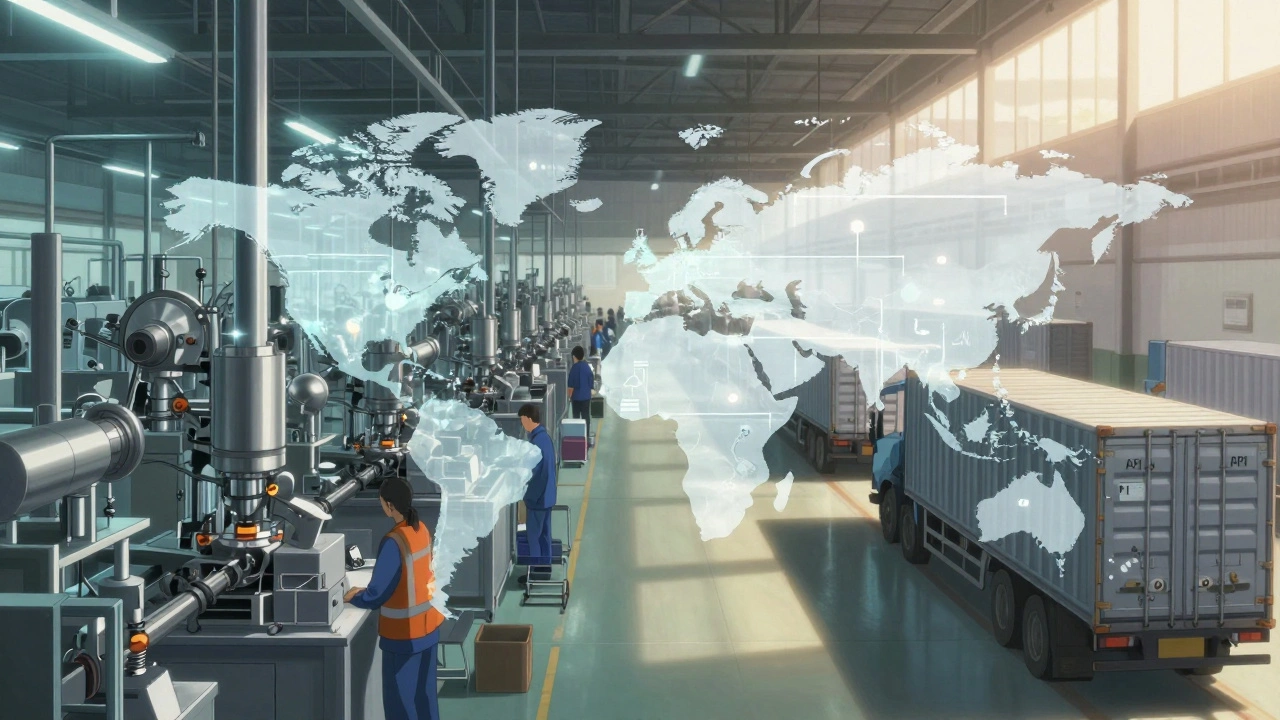
India and China dominate the global generic drug market, with India leading in volume and China controlling the supply of active ingredients. Emerging economies like Vietnam and Cambodia are carving out niche roles in this high-stakes industry.

When we talk about emerging economies pharma, the pharmaceutical systems in countries like India, Brazil, Nigeria, and Vietnam that produce and distribute most of the world’s generic medicines. Also known as low- and middle-income country (LMIC) drug markets, it plays a critical role in making treatments affordable—but not always safe. These countries make over 80% of the world’s generic pills, from antibiotics to blood thinners, yet their regulatory systems vary wildly in strength. That means a pill bought in Lagos might be identical to one in London—or it might not even contain the right ingredient.
One major issue is bioequivalence, how well your body absorbs a generic drug compared to the brand version. In places with strong oversight like the FDA or EMA, generics must hit the 80-125% absorption range to be approved. But in some emerging markets, testing is skipped, delayed, or faked. That’s why the NTI generics, narrow therapeutic index drugs like warfarin, lithium, or thyroid meds where small changes in dose can cause serious harm are especially risky. If a warfarin generic in Nairobi absorbs at 75% instead of 80%, it could mean a stroke. If it absorbs at 130%, it could mean internal bleeding. These aren’t hypotheticals—they’re documented cases.
Then there’s drug access, how easily patients get the medicines they need, regardless of cost or regulation. In rural India, a woman with epilepsy might get her phenytoin from a street vendor. In parts of Nigeria, a man with HIV might use an expired generic because the clinic ran out. These aren’t choices—they’re survival tactics. Meanwhile, big manufacturers in these countries export billions in generics to wealthy nations, where the same pills are sold under strict oversight. The same factory, the same batch, but different rules depending on where the label is printed.
What ties these posts together is a simple truth: emerging economies pharma isn’t just about price. It’s about trust. It’s about whether the pill you swallow was made under conditions that guarantee it will work—and won’t kill you. The articles below dig into real-world examples: how a single generic drug can trigger deadly reactions, why some countries demand stricter testing than others, how patients in low-income regions manage without lab monitoring, and what happens when regulatory systems are underfunded or corrupt. You’ll see how the same science that saves lives in Boston can fail in Bamako—not because of bad science, but because of broken systems.
India and China dominate the global generic drug market, with India leading in volume and China controlling the supply of active ingredients. Emerging economies like Vietnam and Cambodia are carving out niche roles in this high-stakes industry.